Episode Transcript
[00:00:00] Speaker A: All right. I've got the opportunity to meet a lot of people in the tequila world. I've met master distillers, brand owners, fans of tequila, some of the most amazing content creators. But I've got to say, one of the people that I've had the most fun spending time with is this guy right here, Jimmy Villa. Boso Salsa. Jimmy, how are you doing tonight, my friend?
[00:00:21] Speaker B: Oh, well, talking about tequila, you can imagine how great am I going to do it?
[00:00:26] Speaker A: Well, and I got to tell you, the next time I'm in Guadalajara and people are like, do you know a great place to drink really great tequila and agave spirits? My answer is going to be yes, it's Jimmy Salza's basement and I'm coming to your house, guaranteed.
[00:00:42] Speaker B: Yes. You need to try. Well, all of. All of the things that you are watching behind me, believe it or not, is not tequila.
That is, according to other two friends that I have, owning the first largest bayou collection. The other one owns the second largest bayou collection. According to them, I have the third largest collection of bayou outside of China in the world.
So I have almost 100 bottles of bayou, which is all of these that you can see here, including the panda. This is a panda shape bottle with a U.
There is also whiskeys, brandies. All of this is rums from agriculture, rums from the Caribbean islands. So whiskey, cognacs, bayous, grappa, everything in experience. The tequila, believe it or not, the tequila shelf is way smaller.
I focus mainly in the tequila brands where I collaborate and a few other brands, brands that are worth having.
[00:01:54] Speaker A: Well, and for those. For those of you who don't know that Jimmy Salsa is not just a great master distiller, he's not just a tequila guy, but he's a guy that trains other people on how to taste not just tequila, but spirits. Like you. You have one of the most discerning palates from what I understand in the spirit's world. So. So let's talk about that a little bit. Let's talk about the training you just did not too long ago in Mexico, where people were coming to learn how to taste agave spirits and tequila. Tell everybody a little bit about that.
[00:02:30] Speaker B: Yeah, well, actually, they are professional tasters, so basically they understand everything related to the tasting process, which is it's an international.
I can say an international way of tasting, and I mean international with every single spirit. When you are tasting in this contest, the criteria that you have for tasting rums is the same for tasting tequila or the same for tasting whiskey. Because they're not focusing on how intense is the agave or how intense is the sugarcane.
No, there is a some beautiful elements that you need to check when you are tasting that are called typicity and representative. How representative it is for the category. How typical are the aromas for this spirit? How typical are the flavors for these spirits? So that's the beauty of this, that what you are tasting is not something focused on a specific spirit, but it's focused on spirits in general. And that's the beauty of this.
So the people that came, all of them were 150 tasters from 45 different countries in the world.
All of them are experts in some areas.
Another are experts in other areas. Rum, whiskeys, cognacs, brandies, bayous. We had people from China, from Japan, from Brazil, from Germany, and each one has like a specialty. But obviously we all understand pretty much everything surrounding spirits in a global term. But what happened is that for some of them, it was the first time in Mexico, and the tequila that they can taste back in their countries is not the most representative tequila.
So I had a chance to do the masterclass for them, explaining them.
How can you categorize the tequila since the Moss artisanal tequila to the most industrial tequila? Because it is not about criticizing, it's about analyzing the characteristics that you have depending on the process of production that you have for your tequila. So when you are making a tequila with a diffuser, you can say that it is good, you can say that it is bad, but the truth is that what really matters when you are tasting is that you need to understand all the flavors and aromas that are being created in that process of production. It's not about criticizing the process, it's about understanding what's in your grass when you are tasting it. So basically what I did was based on history, which is the beauty of the conversation that I have with them is based on history and based on chemistry. I explain everything that you can find in a glass of tequila, from Tahona tequila with a brick oven to a diffuser, a column steel tequila. So all the ranch of aromas and flavors that you can find in the category tequila is something that we mentioned in this masterclass. And obviously the other part, which was very interesting was that the host of the event was Jalisco State.
So the topic that I speak was Jalisco spirits. So obviously I mentioned tequila, but I had to mention also Raicia And I think 149 of the tasters, they were expecting to know about raicilla. Because maybe 50, 60% of them, they never tasted their bricilla before. You know, it's a category that you can find in Mexico, you can find in the United States, maybe some places in Europe, but most cities, most bars around the world, especially maybe Asia, South America, are places where you are not going to find Brazil.
So all of them were coming to the class like, okay, it's great to completely understand what's happening with tequila being in tequila, because the conversation was in tequila. But everybody was crazy about Brazilia because they say, I want to know how the tequila smells, how it tastes, and what the range of aromas and flavors that we can expect when tasting a tequila to identify the typicity or to identify the representativeness of the liquid. So, yeah, basically, that was the conversation. It was like six months ago.
It was a big moment in my career when I had a chance to do a tasting for 150 professional tasters from 45 different countries. So, yeah, it was a lot of fun talking about tequila and also rice this very cool.
[00:07:23] Speaker A: I'm very proud of you that you got the opportunity to do that. I, I, I know how hard you work and I know how professional you are, and that had to be a really neat moment. So I'm going to ask you a question. But in doing that, since you brought up Raia, I think I'll go ahead and pour a ra.
That's your namesake of a great tequila that you make.
[00:07:46] Speaker B: So it matches it perfect. You have a perfect match.
[00:07:53] Speaker A: Okay, so perfect match.
I just, I just recently purchased a kit. It's called a wine savant nosing kit, because I wanted to train my nose better.
And you have this exquisite palette. So where did it come from? How did you train your nose and your palate to have all of this sensory that you have and be able to explain it? Is it just, are you just born with it or is it something that you've had to work on to create?
[00:08:24] Speaker B: Okay, now that we are in the middle of the workup, there may be. The two most important players in the, in the World cup are Cristiano Ronaldo and Leo Messi.
And when you speak people about talking about both of them, they define Leo Messi as a natural. They say, Leo Messi is a natural. He was born with football. He woke up one day and he was ready to kick a ball. And Cristiano Ronaldo is a guy that was not born with that level of understanding in a brain level of football, but he's such a hard worker and so dedicated and so focused and so concentrated that they, both of them are, for me, maybe in the future, we will recognize them as one of the best moments in the international history of football because we had the chance to see these two playing to each other. But what do I want to explain about these two players is like, you can burn like Leo Messi with the ability of tasting and smelling things, having the chance to really interpret in a very easy way what you are smelling. And some other people need to focus more on doing the hard work. It's like smelling things, trying to remember, doing blind tastings or blind smelling different things in your houses to keep the brain working on finding faster relations between what you are smelling and the understanding in your mind of what you are smelling. I am the Cristiano Ronaldo of the tasting.
Well, no, not. Actually, I'm not.
Let's say in another way, let's say that I need to train like Cristiano Ronaldo to have the abilities that you can develop. I am not a natural. I can tell you, my wife, it's more unnatural than me.
She also is a sommelier like me.
But I think my top reference is Juan Comadre. You know, comadre? The word comadre in Mexico is when I am the godfather of her daughter.
So she and I are compadres.
So she is my comadre. No, she's amazing. I mean, in the persons that I know, really close to me, my comadre Pati is one of the person that she smells. And, oh, my God, this smells like the banana that you used to have in an ice cream when I was 12 years old. And at the top, they put a little bit of chocolate, and then you chew it, and then you wake up on the next day, and it's like a mix of the banana with a little bit of the toothpaste. And he's like, what?
What?
[00:11:18] Speaker A: There's.
There's a podcast I listen to called Whiskey Tequila Fridays. It's a great podcast. And they. They. It's Drew and Matt. One's a tequila guy, one's a whiskey guy, and they'll nose and taste a whiskey, and they'll nose and taste a tequila. And they'd love to have you on your. On their show. You would love it. But Matt, who's on there, is like. He's like, oh.
Oh, my gosh. This.
This smells grassy, but not like normal grass. This is a grass from when I was in church camp when I was 12 years old in North Carolina, and it was noon and the sun was like. It's like, what the hell are you talking about? Yes. But he's able to create emotion around the smell. Right. And that's something that I don't know how to do. I. I bought this kit. I am. I've been doing this series where I.
My wife picks, you know, two or three scents. So I. I smell them and I don't know what they are. And then I. I smell a tequila, and I. I try to smell those in there. And when you smell it, you know, you. You get caramel, and you smell a repo, you get caramel. And it's learning how to identify. But I've learned in my house that, like, when I go to make a peanut butter sandwich, I smell the bread in the loaf and I smell the peanut butter. Like, if we're cooking something, I smell the spices. Like I'm trying to get to where my brain smells these things, recognizes them, and remembers them. Because it's not as important to be able to smell. It is be able to recall what it is. And it's been a lot of fun. And it's really changed the way that I drink tequila or raisia and be able to identify these flavor profiles. And for anybody who's doing this for fun, it definitely widens your availability, your. Your sensory availability to smell different things. It's pretty impressive.
[00:13:14] Speaker B: Yeah. Actually, that's what it is all about. It's about the connection. It's how fast can you identify and translate into words where you are identifying. Actually, I remember one of my teachers when I was a student for Sommelier Augustine.
He's the one that was giving us the class about smells, aromas, and he once told to us, no, okay, you have in front of you, you have like 10 different aromas.
You are going to blindfold your eyes, and then you are going to smell. And then you are going to write down without looking. No, then the paper is all messed up because you are writing without watching. No, you need to write a lamb.
You need to write down what you are smelling.
And that's today's exercise.
And then we were like, smelling something, and I say, oh, my God, what is this? And then you go once, three times, four times, five times. And he was mentioning to us while we were doing the exercise, he told to us, hey, guys, if you don't get it at the second time, stop trying. The connection didn't happen.
You can keep smelling three, four, five, six times, and if it didn't come in that moment, pass to the next one, and maybe at the end you can go back. But if you don't get it at the first time and you don't get it the second, you can keep doing it six, seven, eight times. And the chances to get it is really, really, really low.
What you need to do is to move forward to another aromas and then going back expecting to make the connection faster. And it was something that was in my memory because I said, yeah, sometimes that happens. You smell something very familiar and you say, oh, this smells like. And you, you say, I have it in the tip of my tongue. I have it here. It's like.
And it doesn't come. It doesn't come.
So, yeah, that's what it is all about is having the chance to. To connect as fast as possible the aromas with your memory.
And it's something that when I dig in my relationship with my wife 20 years ago, she noticed when we went the first time together to a supermarket, she noticed that I smell everything. And she's the one that taught me. I never realized that for me it was very normal going to the supermarket and taking fruits and no.
And she told me, why are you smelling everything? And I say, I don't know. It's the first time that I realized I am smelling things.
Yeah.
Even today. Even today when I have a dish or I have something in my glass or something, even if it eats water, I do smell it. So that's my natural part. But I need to recognize that I am not as good as many people may think, because I am not a natural. I can recognize that natural people when they are doing this exercise. But for me, it's about smelling and smelling and smelling and smelling. I need to try harder.
Sometimes I come here to the seller and I go check one bottle and then I go check the other one and I try to identify which one is which one. Because sometimes it's hard to identify when you have age expressions. If I put a cognac with the whiskey, with a tequila, with rum, if they are super aged, let's talk about extranejo in tequilas or something really old in the grom, or very old in whiskey or very old in cognacs.
Sometimes it's really hard to identify the category because the wood standardizes everything. The more wood you have, the more important it is. So it standardize the basics. But the work, really hard work, is trying to find that very old element that used to be the primary aroma that it is hiding behind all of that wood to try to say, okay, no, this is a rum because of this. This is a whiskey because of that. This is a tequila because of that. And this is a cognac. Because of that, without tasting, because of the mouth is the best way to, to help you to finally understand what. What it was. No, when you put it in mouth, it's like, okay, now I have no questions, but no is what you really need to hard to try, really hard to identify difference because they are standardized by the wood expression.
[00:17:45] Speaker A: Yeah, I would agree. Like in an extra on yejo and a 25 year rum and a bourbon, I. I have. I would be able to probably pick out which one is the tequila, but I wouldn't be able to pick out which one was the bourbon or the rum. And you throw a cognac or something else in there and I'm. I'm out. Like, those are just things I don't smell on a regular basis. I've been learning a lot about like cachas and biscos and Mexican rums. You know, like, those are so cool. We. But you dive deep into scotch whiskey and rums that are aged and I'm, I'm out. I. I can't pull those out.
I would, I wouldn't even try. Like, it's. That would be difficult for me.
So. So let's do this. We dove into something real quick. So people who don't know who you are, give everybody a little bit of who is Jimmy Vilaboso Salsa.
[00:18:40] Speaker B: Okay. I am a fifth generation member of a family making tequila.
My great great grandfather was the founder of Tequila Sausa. And many people will say, hey, he's lying. Because the great great grandfather was for Guillermo Erikson Sousa, not for him. Well, he's the same guy for Talesa owner Guillermo Ericsson. Sousa and me, we have something in common, which is our great great grandfather.
What happened is that in the second generation, Guillermo's family is the one that received the distillery. And what my family received in the second generation was a piece of land that we still own where we have been putting agaves since the last 50 years.
But what happened is that in my family branch, we didn't get any distilleries, but we got the land, we got the passion, we got the learning to understand everything about tequila.
And one day I had the chance like 12 years ago that a brand, Suave. Tequila Suave, the owner of that brand came to me and told me, hey, Jimmy, I've been in your tastings and I want to ask you if you can do a tequila brand for me. Well, not the tequila brand, the tequila for my tequila brand.
And he trusted me as a master distiller.
So I didn't have a distillery, but I had a great relationship with the Partira family from Amatito. Done.
So I went with them and I say, hey, there is somebody asking me to be the master distiller of the brand.
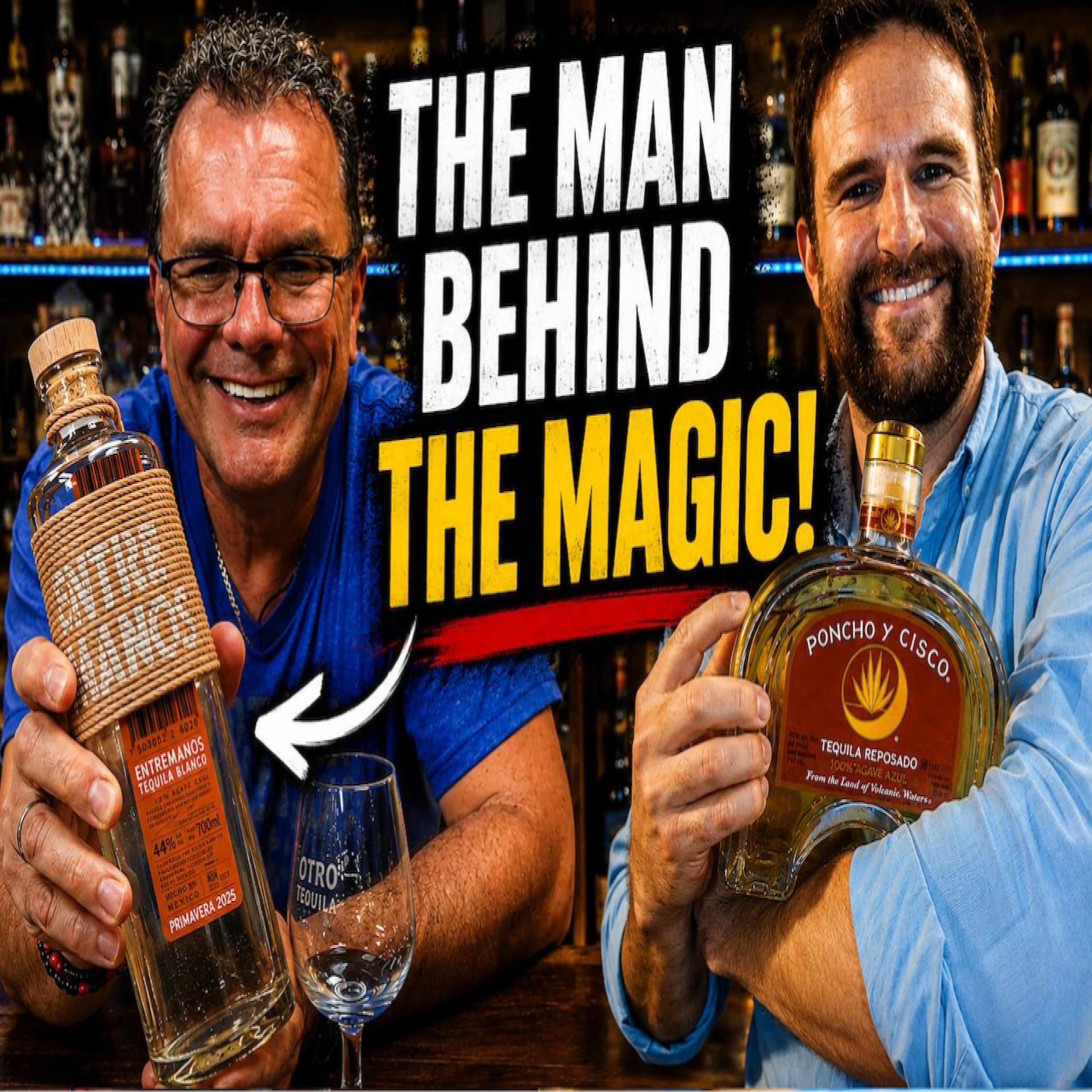
I need a kitchen. I am a cook and I need a kitchen to prepare what they are asking me to. And they say, jimmy, this is like your house, this is your kitchen, and you can consider us your family. And that's how I begin to make tequila almost 13 years ago for other brands. After that brand, many other brands came to me and asked me pretty much to do the same, developing the liquid for them. I can see a few bottles behind a view of the tequilas that I make. I see three bottles of entramanos. I see some cachazole. Yes. Oh, yeah, yeah, yeah. That's the high proof cachazol. Entremanos, Dos Angeles, Tiatula, Ponci Cisco. You have Ponci Cisco, do you have Ponchi Sisco?
[00:21:12] Speaker A: Yes, I do. It's over there. That's the most beautiful little bottle. I love it.
[00:21:18] Speaker B: Yes, this is a very special bottle. Let me go get it. Because people, people say, oh, I don't know what to think about the bottle.
What happened with this one? Many people says, you know what it's like. I don't know what to think about the bottle. But then I explain, oh, the shape makes really easy to carry six, seven or eight bottles because you just put it in your arm like your, that one bottle, your hand. So it's really easy. Look at this. It's perfect.
[00:21:46] Speaker A: So the owner of this brand's like a he, he's like from Fort Myers, Florida, right? Isn't that where he's from?
[00:21:53] Speaker B: Yes, yes, yes, yes, yes, yes.
[00:21:56] Speaker A: Very delicious. And this one, unbelievable. I, I, I do have to find the, the Rosa of this.
[00:22:03] Speaker B: And yeah, Los Angeles.
[00:22:05] Speaker A: This is the only expression I've had, but it's delicious. I need to have the, the brand owners on the show. You need, I know somebody, you should work that out for me.
[00:22:14] Speaker B: And yes, another brand is another brand that I am working with.
They are in the whiskey region, the most important whiskey region in the United States that decided to launch their tequila brand there. So it's another brand that I am making.
So, yeah, pretty much just having fun making tequila for other people, giving their own personality. Because that's one of the questions that I get asked the most is how can you make a different tequila for each different brand? And it's really easy because the question that I make at the beginning is, what do you want for your brand?
Where do you see your brand?
And that's how I can create the personality. For example, with.
With entremanos, they say we're a blanco brand. Okay? So we're making four different expressions of planco.
And each one of them is very, very different by just manipulating the process of fermentation, of graduation of alcohol.
And now we have an expression that it is called castagno, where we put the tequila 15 days in a barrel.
With Hacienda Rio Verde, Los Angeles, we have age expressions where we put the tequila in different barrels for different periods of time. So you can have blancos, reposados, anejos. Also Rosas. Catch us all, Catch us all.
It's all about fun. You know, that brand is one of the funnier brands that I've been working with because James is a super creative guy. And he said, jimmy, let's make seven different barrels. And it's going to be a single barrel edition for each one. So we make one barrel of rum. Eggs. Rum. We make one barrel of eggs bourbon, One barrel of eggs wine, one barrel of eggs merlot, one barrel of eggs cabernet. So it's a super small quantity of bottles, but with a very hard differentiation between each of them. And, you know, he has a beautiful place in Sayulita, in Ayarit. And when you go visit, you can taste all of the expression that he has asked for the brand. And it's like a super fun brand. So, yeah, basically, that's me. It's a guy making fun of making tequila. It's having fun of making tequila and being super proud of having a last name that represents five generations of tequila makers. And also one of the founders of the industry, not the product itself, but the industry. You know, tequila has been made not as a tequila, but as an agave. Spirit has been existing for 400 years. But when you talk about tequila and the typicity of tequila that we have now as a product that we know as we know it today, my great grandfather was one of the main founders of the industry with the Cuervo family, with the Orendine family, with the Rosas family saucers family, all of those were some of the names that put the columns where all the industries being based today.
[00:25:28] Speaker A: Yep. I gotta say, if. If anybody wants to really learn about the history of tequila, I implore you to go get the book Tequila Wars. Ted Genoese has done a great job giving some great history.
I know you. Jimmy also gave a lot of information. Guillermo gave A lot of information. The Beckman family helped out as well. It is incredibly entertaining as a book.
It should be a movie or a television series or something because it's so entertaining and to hear the history of this amazing spirit and the people behind it. And then when you see the bottles on the shelf, it. It really.
It resonates with me and everybody I've known that have listened to it and talked to. We. We were with Ted just recently on a cuevo tour, and to spend time with him and talk about it, it's really amazing. And I, I 1, 1. I want to say thanks for spending your time with him, giving him information that you had. I. He's like. He brought me, like, birth certificates and wills and like, all of this documentation. And I guess Guillermo opened up these file cabinets and said, I don't know what the hell's in there, but check it out. And to be able to hear the stories and what your family is a part of is really amazing, and I think it's really impressive. So you've been working at NOM 1522, and I know there's a tequila back here that I believe you had something to do with some of these as well, right?
[00:27:03] Speaker B: Well, not directly with House of Bread. I mean, Miguel bought one distillery and Miguel has partners in the distillery. So basically, as a group, they invited me to do something with them.
So I've been producing tequila in that distillery. It's a beautiful. I don't know if you have been there in the distillery.
[00:27:27] Speaker A: I have not.
[00:27:28] Speaker B: Okay. The views are amazing. If you follow me. If you follow me in Instagram, I don't have many followers. I need to say that because I am not an Instagrammer or an influencer.
[00:27:40] Speaker A: So everybody that's watching this needs to follow Jimmy. We have these celebrity master distillers that we talk about all the time. And I just was doing an interview with arf, our mutual friend, Oscar Vasquez Camarana.
And Oscar pointed out that you are one of the premier guys out there making amazing juice. So you follow Oscar, you follow Sergio Cruz. You gotta start following Jimmy because he's amazing. So there's my pitch for you, Jimmy.
[00:28:17] Speaker B: Thank you. Thank you. Thank you so much.
[00:28:19] Speaker A: Jimmy.
[00:28:20] Speaker B: Jimmy V. As Villa Lobo. Jimmy V Sausa. That's my Instagram. Jimmy V Sausa.
And when I had. When I am driving to. To Miguel distillery, there is one spot where I always stop in the morning. And when I'm coming back home, there is one spot where I always stop and it's amazing. How different the same spot it is day after day. I mean, in the dry season, it's not that different. But right now that we have rainy season, sometimes in the morning you don't see it because from that point you can see the Tequila volcano. And sometimes you don't see the Tequila volcano because everything is cloudy. So you don't see it. Sometimes the day is super clear and you just see the full volcano. Sometimes you see clouds in the top of the volcano. Sometimes it is the sunset, sometimes it is the sunrise, sometimes. And it's amazing because I take a picture every, every time I pass through there.
So what I am doing with Miguel and House of Rare basically is collaborating with them in the distillery.
We, Miguel and I had a lot of communication on Jimmy. What do you think about this? What do you think about that?
Let me improve this profile of tequila. I've made a couple of batches of tequila for. For him. A.
I don't know what he does with the tequila. He just asked me for make tequila and I don't know if he drink it. I don't know if he sell it. I don't know if he shares. He shares the tequila.
But yeah, my relationship more than with the House of Prayer is with Miguel and the distillery that he's owner with other partners. And it's a place I really enjoy being there. It's a beautiful. The views that you have there are just amazing.
And I am just beginning to understand the distillery. You know, it's like I say that making tequila in a distillery is like having a child. When you have a baby and it's a newly born baby, you don't know why he is crying. Oh, it is crying. And he is like, oh my God, why it is crying? No, give it milk. And then it doesn't stop crying. And then why is it crying? Or change the diaper and it is still crying. You say, I don't know what's happening. No, you need time to understand that, oh, it's crying because the baby has gases. So you need to pump an oil and that's it. No, then you begin to realize why the baby was crying or is learning to know or understanding your baby. And it's pretty much the same with a distillery. When you are beginning to work with a distillery, you need to understand what happens if I modify something here, how it will translate into the product.
What happened when I am making tequila in January or what happened when I am making tequila in May, or what happened when I am making tequila in August. If I am using or not using yeast.
So so far I've been working in the distillery less than one year.
So I don't have a full cycle in the distillery. But now I understand the equipment. No, the equipment. I already understand it. What I need to understand is the natural conditions happening around the distillery. Because in January we have the largest fermentation that I have ever had in my life. You know, the record for me was like 12 or 13 days, my largest fermentation time. And this distillery in January, it was a 17 days fermentation. It was a record.
And it's because of the conditions of the weather, but especially the conditions of the distillery.
The ceiling of the, of the distillery, it's really tall and the fermentation tanks are really low.
So when it is hot out there and then the ceiling begins, the roof begins to get hot. The hotness goes really, really, really slow to the fermentation task.
So the fermentation activates really late in the day. If you go to 1522, which is a Cindadero, you can go visit the fermentation tanks and you are looking the fermentation tank like this and then you can touch the ceiling. It's like less than 1 meter away. So the hot of the outside gets into the fermentation tank like this. Even in winter, what was happening in this distillery in Arenal is that the temperature is going really slowly, it's getting hot. So fermentation begins to activate. Maybe 10:30, 11:00am in the morning, you begin to see how the activity is just beginning again in the fermentation. But before that, nothing is happening. The fermentation is almost completely stuck.
And that creates a very special complexity in the liquid. So, yeah, I'm still in the process of knowing the environment of the distillery. And it's something really beautiful because as soon as I completely understand that, you begin to take decisions depending on the seasonality, the temperature, the rainy, the dry, the cold, the hot season, to be able to create many different profiles inside of the distillery.
[00:33:37] Speaker A: So in that timeframe, because it's longer, does it create a malolactic fermentation or fermentation stops and then restart so it doesn't go malolactic in a, in a quick timeframe.
[00:33:49] Speaker B: You know, actually you may think that it is a more malolactic result than what really is what happens when you have longer fermentation. What really affects effects in this case more than the malolactic is the creation of esters. You know, the esters is the fusion of two molecules. When you have a fatty acid and it is mixed with an alcohol, you create an ester. And it's like a relationship. No, the first time you met your wife or the first time you saw your wife, you said, wow, this is a very beautiful woman. And maybe in your mind, you decided to be with her the rest of your lives. But it's not like, hey, I just saw you. You and I are gonna get married and we're gonna live together forever. No, and imagine if you say that to her, it was like, are you crazy? No.
She will say to you, you are not that bad, but you are kind of crazy. What needs to happen is time. It's time for the relationship to happen.
It's the same with people than with molecules. You have molecules of fatty acids floating and you have molecules of alcohol floating. But it's not like, oh, they are attracting like madness. Not like I'm creating esters everywhere. No, it doesn't happen like that. They need to find each other and then create a bound to form a new molecule that in this case is esters.
You have heard about mezcales that have glass maturation.
Glass maturation is no other thing different than esterification process. That one is called chemical esterification process.
And the one that I mentioned you is biological steriliscation process.
So basically, the longer is the fermentation, the more chances you give to the product to create different compounds. So they will be more complex products at. At the end. So, yeah, that's what happens when you have longer. And also it gives the chance for malolactic fermentation to happen, depending obviously on the concentration of malic acid that you have at the beginning and the influence of bacteria, lactic bacteria that you have in the environment.
To understand the final result. When you see the distillery, we're surrounded of an agave, beautiful agave field, and an eucalyptus forest.
So it's a pretty clean environment with no contaminations, with no other factories or distilleries or anything surrounding us. So it's pretty much what we get from there is the natural expression of the environment in a very pristine area where the distillery is.
[00:36:39] Speaker A: So the cleaner you are in fermentation, the less malolactic that you have. Is that right? Because there's less bacteria in the. In the environment.
[00:36:50] Speaker B: It's two things. One of them is the presence of lactic bacteria, which are the one taking charge of the malolactic fermentation, and also the malic presence of the acid in the. In the agave. So, yeah, it's.
It's a matter of two things. That need to have a more.
A larger presence, to have a larger expression at the end.
So, yeah, usually longer fermentations not necessarily means more malolactic. Actually, now that you are into raecillas, when you taste ricillas from La Sierra and from La Costa, you can identify that one of them. It's very malolactic. It's one of the main characteristics, and it's due to the conditions, and it's mainly due to the characteristics of the agave because, you know, the resillas are Costa and Sierra, and the agaves that they are using, using are different from one region to the other one. So that's why one of them is malolactic and the other one is not. Because one of those agaves have a higher concentration of osmalic acid and the other ones doesn't. So that's one easy way to try to identify which one are Sierra and which one are Costa. Depending on the agaves and depending on concentration of malic acid and depending on the result after the malolactic fermentation.
[00:38:13] Speaker A: Yeah, you just went way deeper than my ability to identify riceas.
So that's pretty amazing.
[00:38:21] Speaker B: Yeah, yeah.
Next time. Next time you come, let's take at least a couple of days because, you know, from Tequila, it's a three hours driving to Mascota, and they have a store with where they have like, 60, 70, 80. I don't know, different races.
And you can completely understand.
What is Resilla de la Sierri? What is Resilla de la Costa?
[00:38:44] Speaker A: I have to say that the minerality of this one, the agave that you get in it, the citrus notes and a little bit of smoke in this, it's very good. But what I like the most about it is the minerality. And I know that they've changed labels and changed the name and everything a little bit, but I. I got this last time I was there. The. The place is beautiful. It's. It's like visiting Jurassic park or also going to Hawaii. Like, if people don't understand how much Nayarit and the Puerto Vallarta area looks like Hawaii, it's so beautiful and such an amazing place to visit. And I, I. Yes, again, I'm gonna hit Monty up. I'm calling him when we're done. So, yes, I have a question for you. So one of the. One of the things that we. We talk about in Tequila so much is the tona. We. We romance this Tona stone. We talk about it like it is the thing. And what I've been asking my favorite Distillers is.
Is it really the stone that makes a difference or is it the process that you use when you use a tohona stone that makes the difference, or does it really matter?
And that's my question for you as you pour some fortaleza. What fortaleza did you just pour there?
[00:40:09] Speaker B: Well, I knew. I knew that you were going to ask me about Taona, so I got this.
[00:40:14] Speaker A: Oh, so you pulled out?
[00:40:15] Speaker B: S.
Yeah, sorry. San Matias Taona.
[00:40:19] Speaker A: Yep.
[00:40:21] Speaker B: And then I have the Casca Wintaona.
[00:40:24] Speaker A: Oh, that is so good.
Shout out to Chava for that one. Amazing.
[00:40:31] Speaker B: And this is the 40. I have also the 46, but this one is the 44,000. So, yeah, I have three Tahanas next to me to talk about tahana.
Okay. You know, Monty, he says to me, jimmy, you have a superpower. And the first time he told me that and I said, yes, I know making tequila. And he told me, no, no, no, it's not that one.
Oh, no, no, it's not that one. No, it's not that one. Your tequila is good, but not as a superpower. No, he told me, jimmy, you have a superpower.
Your superpower is analogies. How can I tell you about the influence of the Taona in a tequila? Imagine that you take F1 wheels and you put them in your car.
What do you think it can affect the result on how you are driving through the corners and braking and accelerating?
How do you think they will help your car to get a faster, more steady, easiest to drive when you are taking cars at a super fast speed?
So that's how I want to try to explain what the Taona can represent in a tequila.
I'm pretty sure that if you have a Formula 1 tires in your car, definitely. If you put the. If you put the sport mode in your car, you will have a better driving, a better experience in the full car.
Unless it begins raining. No, because you know that in Formula one you need to change tires when it is raining. But if it's not raining, I'm pretty sure that your car, if you have a sports mode, it will be behaving in a better way. It's going to be like a completely different car and a supercar, a fast car, and it's going to behave like a Formula one car. No, because you are not changing the full car. You are changing that one component that will create some difference in the car at the end.
That's what the Taona is. The Taona is not the element that creates a completely different and A super unique and a delicious product compared to a traditional meal. No, it's one element that if you have good conditions in pretty much everywhere, in every other stage in your production process, the tamona will give the personality to the whole. But it is not like, oh, my God, you just put F1 wheels to your car. Now you are going to drive 350 kilometers on the highway. No, it is not.
You need to give the right dimension to the town. It's a beautiful way to do extraction in a very representative and historical way to make a tequila that will give to the personality of the tequila what it should give. But it is not like that's going to completely change the full spectrum of tequila. Because it is not. It affects. Yes, it will create a difference from a traditional meal if you have the same process, same production, same oven, same fermentation. Yes, it will create a difference too big.
No, because it's just one element. It's just one part of the production process.
Hmm.
[00:44:18] Speaker A: That. That's been my thought all along is it's not necessarily the fact that it's tohona crushed, but it's the fact that you. You cooked it, you tohono crushed it, you fermented with fibers, you did this whole process that's different, that creates a different tequila.
[00:44:38] Speaker B: Yeah, yeah. Actually, I can tell you the best example that I have is andromanos.
In Tremanos, we have four tequilas blancos.
Thank you.
Within Tremanos, we have four tequila blancos. And each one of them is very, very different.
What's the main difference from the. Yeah, that one. I was going to mention that one. That one is primavera.
The difference between primavera and the traditional blanco is that primavera, it's fermented in wine barrels. So when I used to have 500 liters wine barrels storage in a warehouse abandoned, and I say, what tequila do I want to put in a 500 liters
[00:45:26] Speaker A: barrel?
[00:45:26] Speaker B: And I say, well, I don't have a reason to do it. I mean, no, I don't have a reason.
So I say, let's not use it for aging.
Let's use it as fermentators. So what I did is that I took the barrel, I put them on one side, I removed the top of the barrel, and I use it as a fermentator.
So what's the difference between the blanco and the primavera? Is that the blanco is fermented in stainless steel, 22,000 liters, and the Primavera is fermented in 500 liters wood barrels.
And that's the only difference. Well, and the percentage of alcohol, no, Primavera is 44. Blanco, it's 40. But even if you dilute the 44 to 40, it will not taste the same. What's the main difference or the only difference that you can find beside the percentage of alcohol? It's how I ferment it. And many people ask me, jimmy, so that means that you have wood aromas and wood flavors in the product because it was fermented in a barrel. And the answer is no, because the intention of the wood is not by giving personality or aromas or flavors to the must. Remember, we're talking about the must, not about the tequila. It is a must.
But what happened? Imagine the best way to explain you how different can a fermentation be for the same brand with the same process, except fermentation? You have a 22,000 liters stainless steel tank, and when the temperature outside is getting hotter, the temperature will go up 10, 12, 13, 15 degrees. And inside of the fermentation tank with 22,000 liters will go like this, like 1, 2, 3, 4 degrees. So outside you had a variation of 20 degrees, and inside you have a variation of 4 or 5 degrees of temperature. Yeah, so when the temperature is outside is dropping, it's changing 20, 22, 25 degrees outside. And the temperature inside of the fermentation tank with 22,000 liters will change for 2, 3, 4, 5 degrees. So the outside temperature is like this.
The inside temperature will be like this. Okay, so you have less variation than the outside. What happens when we do it in 500 liter fermentation tanks, if you go, if you go at 6am in the morning, you put your arm inside of the mast and it is cold, not fresh cold. Because outside is cold and the most is cold. And that's 6am in the morning. But as soon as you begin to see the sun rising, you begin to see the temperature of the must rising. And when you see a little bit of the sun, you can see the bubbles happening, the fermentation, because it's a super active fermentation.
So what happened is that the temperature outside is like this, and the temperature inside of the barrel is also going like this. Really hot, really cold. Really hot, really cold. So these variations in the temperature between a 22,000 liter stainless steel tank and the variation in a wood barrel with 500 liters, the difference that you have in these two tanks will create very different fermentation processes and as a consequence, very different results. Remember that the percentage of a fermentation in a spirit is somewhere between 35 to 40% of the final product.
The way you manipulate a fermentation can affect between the 35 to 40% of what you have in a final spirit compared to a fermented beverage, compared to wine, compared to beer, compared to, I don't know, tepache pulque.
The fermentation represents maybe 80, 85% of what happens. The rest of it can be many other different sources of things, but fermentation can be 60, 65, 70, 75, 80, depending on what you are making.
But in tequila, it's somewhere between 35 and 40%. So these two fermentation processes in intermanos create very different profiles in the tequilas due to the manipulation on the containers.
This is another way to explain to you how much impact do you have from the taona? The Taona also is giving you a percentage of variation. What really matters when you're talking about tauna? What really matters?
First of all, it's something that people believe.
I know many people will say, oh, this guy is crazy. And some of them, if you ask me for the right documents, I can share with you.
Many people think that the minerality of the tequila comes from the town.
Okay, let's be completely strict on minerality. When you talk about minerality, you speak about minerals, okay?
And in the just the steeled spirits, there is no minerality. Okay, why?
Because minerals are too heavy and minerals doesn't pass through the distillation process.
Okay?
So when you are talking about strictly minerality, that means we are talking about minerals.
There is no minerality in just finish agave spirits. And it's not something that I said, it's something that the story was made like 10 years ago, it must like 15 years ago.
When they analyzed the land where the agave was growing, they analyzed the agave when it was harvest. They analyzed the mosques, they analyzed the most before the distillation, and they analyzed the spirit when it was finished. And the results says that 99.9% of the minerals that were at the beginning of the process in the agave disappeared through the process of production. So when you are talking about minerality, specifically minerals is not related to the toner. Okay. What happened is that many people relate aromas to what your mind, your memory, defines as minerals.
[00:52:05] Speaker A: No.
[00:52:05] Speaker B: For example, a pencil. Well, I don't know what not pencil is. Yeah, but you know graphite. No, it is graphite.
[00:52:13] Speaker A: Yeah, yeah.
[00:52:13] Speaker B: Do you say graphite? Okay.
[00:52:15] Speaker A: Yeah, yeah.
[00:52:17] Speaker B: There are so many wines where you smell them and you say, oh, this one smells like graphite. The aroma, graphite from the pencil.
It's something that you can actually find because the grapes do take minerals from the soil and take them to the grape.
But considering that this doesn't happen in the just finish spirit, the mineral source can be two things. One of them, it's real minerals coming from the water for dilution. If you are diluting your tequila with water that has a source of water that has minerals, all those minerals in the water will end up in your tequila glass because it was used for dilute the percentage of alcohol of your spirit. Or the other one, which is the one that makes the most sense is that your mind is relating the aroma to something that reminds you as mineral.
It's like, for example, minerality. Many people define petrichor. You know petrichor, what petrichor is?
[00:53:19] Speaker A: Yeah, yeah, the concrete. Wet, wet limestone. Wet sidewalk, wet concrete.
[00:53:25] Speaker B: Yeah. We are here in Guadalajara, you know, the most Mexican. One of the most Mexican songs where it says, guadalajara, tirra mojada Guadalajara. You smell like wet dirt. That's what the song says.
[00:53:42] Speaker A: Yeah.
[00:53:42] Speaker B: And that's. Yeah, that's a petrichor. And petrichor can be an aroma that somebody may define as mineral. But the truth is that when you analyze the petrichor components, there is no mineral there. It's pretty much like a bacteria with some ozone happening. And it's something that in our brain, we can relate in a glass as something mineral when we don't have any minerals in the glass. Right.
So, yeah. Taona.
What happened with Taona?
The most important part that I can tell you about Taona is that the method of extraction. And I will use another analogy again, because it's my superpower, you know? Do you know that the extraction of the grape juice before was having people stepping on the grapes?
[00:54:40] Speaker A: Right? Yeah.
[00:54:41] Speaker B: You have seen many. You have seen these many times people stepping on the grapes to extract the Jews. Do you know why they do it like that or why they used to do it like that?
They did it to avoid the crushing of the seeds and to avoid too much crushing of the skin of the grape. Okay. In the skin of the grape, you have many, many, many things.
Yes. Yeah. So in this very gentle way of extracting, mainly you are avoiding the crushing of the seeds.
[00:55:21] Speaker A: You.
[00:55:21] Speaker B: I'm pretty sure that you have ever buy the seed from a grape and you know how bitter it is and how the tannins is horrible.
And also there is a little bit of greenness in the skin of the Grape that it is not completely desirable. So the best way to extract the juice was stepping on the grapes to extract the juice without crushing anything.
That is the tauna.
When you are extracting the juice from an agave, what you are doing, you are stepping on the fibers. It's like stepping to extract the juice without breaking the fiber.
If you compare that to a shredder, if you compare that to a traditional meal, what you're doing in the meal and what you are doing in the shredder is breaking the fibers of the agave to extract the juice.
And just by simply doing this, you will get in your tequila different components than when you are just stepping on the fibers with the taona.
That's the main difference on using a taona with an agave meal. Is this going to be the huge difference? No, again, it is not. It is important.
Yes, in a percentage, it can represent an important percentage that you can smell and you can taste and you can feel in your mouth. Something that happens that you can see in a chemical analysis when you are using a taona. It's the methanol.
You know the methanol. It's been created when you are breaking the fibers of the agave. You know when the, the beginning of the creation of methanol in the agave is when you are harvesting the agave.
Since the moment you put a coa and cut the leaves from the agave, you are already releasing the enzymes that will create. Since you cut it, you will be releasing the enzymes that will create the methanol.
So consider that when you are squeezing the juice with a very soft extraction. Well, soft extraction with a taona, or by breaking the fibers with a meal, you will also extract more enzymes and you will create a little bit more of than when you do with a tauna.
[00:57:51] Speaker A: But do you think that's what it
[00:57:53] Speaker B: is all about, the tauna?
[00:57:55] Speaker A: And do you think some of the tahona flavor comes more from the process that we, we usually ferment with fibers versus not fermenting with fibers, that we get more flavor from the tojones because we use fibers in fermentation?
[00:58:13] Speaker B: Okay, maybe, you know, there are two kind of people.
The people that knows about tequila and the people that know us knows about tequilas. Okay. Yeah, I, I consider myself as a knowledge, as a knowledge. My knowledge is about tequila, but no tequilas.
But you, you are tequilas. You are a tequilas and a tequila guy.
Help me to think in a brand that has two expressions. One of them with taona and another one without taona. With the same percentages. Because I know, for example, Casca Gwynne, it's 40, it's 48. 40. Oh, no, the Taon is 42. I don't know if Cascaguin has a Blanco 42, but if you compare the Taona 42 with a Blanco 42, that it is not taona. But it's important to know if the rest of the process is pretty much the same. No, that's what I tell you.
[00:59:08] Speaker A: So here's a great example.
El tesoro alta soro blanco, all tojona. And then fermented with fibers and then tapatio, which is a percentage of tohona, distilled or fermented with fibers, and then fermented without fibers and part roller mill. You can taste the difference between tapatio and altassora.
[00:59:35] Speaker B: Okay, that's a good example.
But be careful because. Oh, this is a super complicated topic. I mean, we can speak about three days about this topic. Okay, let's. Let's try to make it two minutes. Let's try to make three days in two minutes.
Don't run to the store to buy those two tequilas.
Why not?
Because if one of them was made in January and the other one was made in May, the main difference between both of them is not going to be that. That difference. The main difference is going to be the temperature that you have in the outside, the. The time of the fermentation.
You know, when you are distilling. It's very interesting, but when you are distilling, the temperatures and the pressure that you need in the steel to get the drops is going to be completely different in winter, in the morning at 6am, 7am than at 12pm the time that you need to, you know, the first, when you are beginning the distillation, the first drop that. The first drop that you receive when you turn on the steel.
We call it rompimiento. No, the rompimiento in winter can take one hour.
The rompimiento in summer, it's 30 to 35 minutes. Yeah. So it can be 40% longer than rompimiento in winter than in summer. Just because the outside temperature, even the cooking, if you are doing the cooking at the beginning, it's going to be slower in January because the outside is cooler. Or when it is raining and you have the oven outside and the oven is receiving rain, it's fighting against the heat inside. So you need a longer cooking process.
So the seasonality is super important to define. So if you tell me, Jimmy, let's break this Question down. Okay, let's go to one of these distilleries and let's say, okay, guys, we're going to separate the same batch of agave.
We're going to separate them after the. In this case, what really matters is the extraction. So we cook the same agave, same cooking.
Then we separate it for the myelin for the extraction. One of them are going to be taona, the other one are going to be meal. Then we're going to keep it separated by using separated fermentation tanks. And we're going to distill tank number one with taona and then tank number one with milk, then tank number two of taona and then tank number two with mio. And then the result of doing this exercise is going to be the closest that you can get to completely analyze the impact of a taona or a meal. If you are not doing it like this, you open the chances. You open the chances for 1,000 things to happen.
[01:02:51] Speaker A: Yeah.
And it goes back to what I was saying. We romance. The idea of the tojona.
And although I think most tohona tequila I've had is. Is amazing. They're really good. From Manifesto 56, from Trujillo to the tequilas, from.
From cascaline to the tohono product that came out of Viva Mexico, the Tohono product of Lost Lore. The like, A lot of them do taste fantastic, but it's not, in my opinion, just about the stone. It's about the process, which is what you've said. Others masters sort of said the same thing.
We romanticize this rock, but it's really the process that makes the difference.
[01:03:40] Speaker B: Yeah. Yeah. Is again, it's like putting an F1 wheels to your car. It will change gas. It will make it an F1 car.
[01:03:48] Speaker A: No.
[01:03:49] Speaker B: No.
[01:03:50] Speaker A: Well, Jimmy, I want to say to you, thank you so much for taking your time, your knowledge, our friendship to do this video. I appreciate it so much. I love talking to you. I can't wait to do it again in person.
And just this, thanks for spending your time with me tonight away from your family. I appreciate you so much.
[01:04:10] Speaker B: Thank you, Brad. And I hope we can meet again in person and. And in any other video. Many, many things are coming in the next maybe two, three months. So we will stay, communicate to let you know many things that are happening and are very interesting in the industry, especially with the tequilas that I am making and my new collaboration. So let's keep in touch.