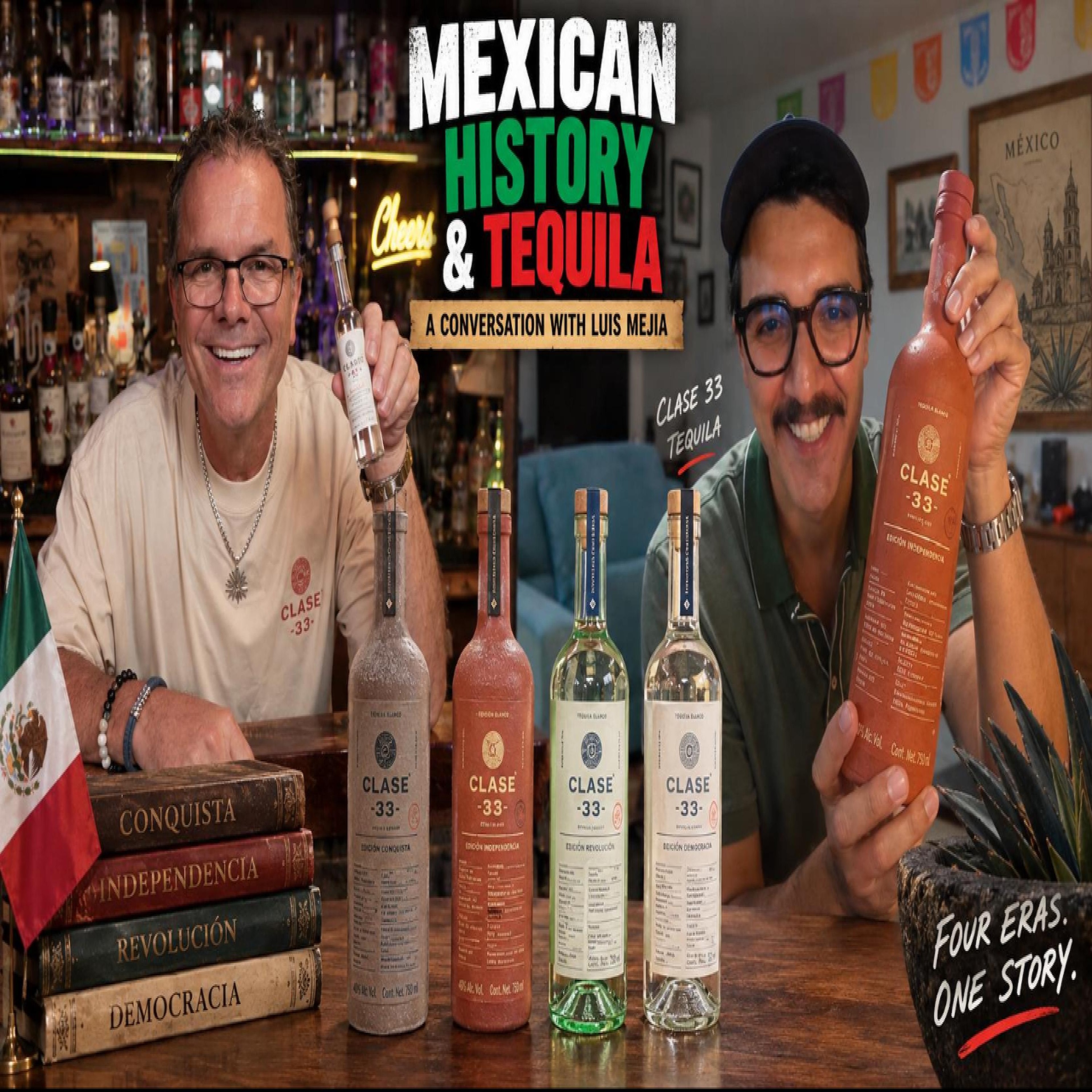
[00:00:00] Speaker A: Are you ready for a tequila lesson in history and all of Mexican history? Today you're going to get one from Luis Maquilla. We're going to talk about this brand right here, and we're going to go through four different methods of production of tequila. Where they're made, how they're made, why they're made, and what time frames they connect to in the history of Mexico. This is a pretty interesting interview with a lot of great information, so stick around.
Tequila with bread.
[00:00:35] Speaker B: Tequila with bread.
[00:00:44] Speaker A: All right, I'm fired up about this one because we're going to talk about Mexican history and tequila with Luis Mejia, who I think from what I've been learning is the historical, like, leader in Mexico. How are you doing today, Luis?
[00:00:59] Speaker B: Doing mighty fine, Brad. Enjoying, enjoying the weird summers we're having here down in Mexico, specifically in Mexico City. But other than that, we're doing just fine. It is September now, so we're getting ready for Independence Month. So we are readying up all of that celebration for upcoming Independence Day.
[00:01:18] Speaker A: I have to say, one of the funnest times that my wife and I have had in Mexico is last year. We flew into arandes on like September 11th. We stayed through our wedding anniversary, which is a very important date. It's September 16th.
And we watched the horses come into arrandas and spent the whole evening celebrating Independence Day and then woke up on the 17th, had a great day and came home on the 18th. And I gotta say, if, if somebody wants to spend an amazing time in Mexico, I think that is a fantastic time to go.
[00:01:53] Speaker B: Listen, I, I, I really do enjoy fourth of July celebrations in the one does it better for independence than Mexico. I, I, I have to say, yeah,
[00:02:04] Speaker A: it, I make the joke here. It's like all we do is blow some stuff up and eat some hot dogs and drink caps, brew ribbon, you guys, make a week of it and celebrate your actual history and the reason why Mexico has its independence. And it's so much more of a deeper, traditional time frame than what we do here. It was very impressive to learn about it and to be there.
[00:02:26] Speaker B: And don't worry, the partying still happens. And that's. Listen, as someone involved in tequila, we need to make sure the party is still going on as well.
[00:02:35] Speaker A: Well, a friend of mine who's a master distiller, who I drink with a lot when I'm in Oranda said the reason he goes on vacation that week is because there's too much drinking. So if that says anything at all.
[00:02:49] Speaker B: Understandable, understandable.
[00:02:51] Speaker A: Really?
Well, tell everybody a little bit about who you are. Let them meet Luis. Sure.
[00:02:57] Speaker B: Well, my name is Luis Mexia and I'm part of the team with Classe Train Ditris. While I may not be a master distiller or I do not have deep roots within Jalisco or Ananda's or tequila from a long time, I'm actually from Veracruz, Mexico, around the Gulf Coast.
I joined this team of.
Of master distillers and really a tequila family with. Because I am both a journalist and a historian, and I am a really a fan of Mexican culture and tradition. And with those abilities of research, I was invited to be part of this team of place, which is a tequila that wants to bring back history into each bottle. Right. We like to say that tequila is a national drink, and it really is. It's the national drink. But oftentimes we misplace our pride into this drink. Why? Because it just becomes another liquor, another spirit to drink rather than.
Well, there's a history, a long standing history of, of agave spirits in Mexico.
We noticed that no one else had taken the. The connection between Mexican history and how Mexican history influenced tequila or agave history.
And we wanted to bring, like I said, the history back into each bottle. Right. And so with that, I joined the team with my research knowledge and, you know, history information. The rest of the team, we got together and developed this brand that. Or came into this brand that was already in the works and we solidified it. We figured out what was the story we wanted to tell with placetrain tight, why we're telling it, and how to take advantage of the fact that we are a very limited team, very small team, but with a tradition that backs us up and with the desire to appeal to as many people as we can, despite our limited resources if we want.
[00:04:59] Speaker A: Okay, so before we dive into the tequila and all of that part, where did this guy from Veracruz get this amazing English?
[00:05:07] Speaker B: I actually was, was lucky enough to spend the majority of my academic life, if not my most form years in the United States. I spent high school, perhaps a little bit of seventh and eighth grade in St. Louis, Missouri. And then after high school I moved up to Chicago to got a degree in journalism, multimedia journalism. So not only was I in the US for nearly 10 years, but also I was working in radio. So you kind of have to train the speaking side of things and the broadcast side of things. So that is, I guess, another element to why I joined the team as well. We wanted to have this reach, but the reach also helped out that I can speak both my native tongue, Spanish and very Midwestern English.
[00:05:57] Speaker A: Yeah, you do have the Midwestern English town for sure. It's awesome. And I've watched several of your videos that are in Spanish, but I don't know that I've caught many videos that are in English. Are you doing on your Instagram English videos too?
[00:06:10] Speaker B: Yes, we actually have a separate account that is entirely in English and focus to a. An American audience. Right. So we, we, you know, we understand that a Mexican audience will have more context on several historical events that happened here. So when we make a similar video in English, we make sure to appeal to a US audience, both by using English and you know, having grown up there, knowing what they teach you in high school, middle school and college, I kind of, I can tell one information to tell people in English. But yeah, we, we, we handle both accounts at the same time.
[00:06:49] Speaker A: So I must be following the Mexican account. So what is the Instagram handle for your English account?
[00:06:54] Speaker B: The English account is Classe Trintitres Tequila or Tequila, while the Spanish one you will find as Tequila classetraintai, Tres mx.
So we just switched the article around and added the MX to make sure that we know it's the Mexican one.
[00:07:12] Speaker A: Let's talk about that channel because one of the things that I have really enjoyed learning about, not just about tequila and agave spirits, but is the people, the traditions and the culture. And when we're driving, you know, to around this and I tell somebody this is where like the last battle happened for Mexican independence and the waters in this area ran red with blood and from theirs when they won. I believe that is close to Tepethead land or whatever the town is where the water is there.
I've had people explain that to me and I think that is so cool. And then for you to put together like this booklet that you have and, and the history and then the way you explain it is, is so amazing. So what, what really was your trigger to decide to do a channel that explains like all of this deep history?
[00:08:02] Speaker B: I think it goes back to, to what I was saying earlier. It just goes back to this, to the, the main idea of this brand is we are recreating the historical processes of tequila production from all the way in the 1600s to through the 1800s, 1900s and now we're already following that through line. And whenever we do tastings and we have more personalized interactions with the brand, we give a broader context to all of those specific brands events. Right. So our bottles are named Conquista Independencia, revolution, democracia. So conquest, independence, revolution and democracy. So now, right?
And so many things happen in the span of 500 years, right? So many changes in, in technology, so many changes in, in cultures, in. In cultural understandings of drinking or, or even acceptability of drinking, of the brand. So we knew that it wasn't enough just to say, oh, hey, this is independencia, and this is what happened then, and this is why this happened. It's a broader story, right. I'm also having had a background in journalism, no one ever gets the full story in a single article.
[00:09:21] Speaker A: Right.
[00:09:21] Speaker B: If you go on a deep dive on any story, regardless of whether it be a sports news story, a gossip, or even a history book, you need time to tell that story. And even though we are doing snippets, brief snippets for people to, you know, be entertained by listening to Mexican history, we're still giving you that context that, you know, will seep into your experience of drinking Classe Train Tai tres once you actually do. Right? And not only that, we are very proud of our history. You mentioned it yourself, the people here, whenever we celebrate Independence Day, we, we. We are proud of our heritage, of our cultures, of our traditions. We want to explain people why we are, in a way, justifying ourselves as to why we're even having this product exist. Why should we pride ourselves in this history? And not to bottle it? Here's the background and here's all of the. Of the context behind it.
[00:10:13] Speaker A: Yeah, that's awesome. And I love the way you've done this because you have given four different expressions that literally meet the time of those expressions. So who was the person that came up with actually starting the brand and this concept?
[00:10:28] Speaker B: So the person responsible is. Is where. It's the Camarena family, but the most current generation of the Camarena, of the Camarenas, you might know people like Mauricio Camarena, owner of Tequila Carrera. Right. His son, his son. And now the. The generation of. Yeah, just the young, the young new people in the game, in the tequila game. So Mauricio, who's, Who's Mauricio's son? Mauricio Camarena, his son. He came up with this idea probably around eight years ago, nine years ago, brewing in his head of this, this. This concept of trying to bring history and tequila together. But he didn't have a way to. To join them. Right.
And, you know, he wants to continue this or he's expected as the new generation of the Camarenas. To continue this family name, family tradition. So he was kind of joining this idea of tradition through his family. Let's combine it through Mexican tradition as a whole.
And that's when he started working on it. And then once we came into the project around three years ago, we started actually ironing out the details to. To get it to where it is now. But most of the heavy lifting was done by. By Mauricio.
[00:11:45] Speaker A: Very cool. Now, since we all know the Camarana name, we know Felipe and Carlos. And so where's his relationship with Felipe and Carlos Leaf?
[00:11:54] Speaker B: It's uncles.
[00:11:54] Speaker A: It's.
[00:11:55] Speaker B: It's his direct uncles. Yeah, direct uncles. Or at. At this point, honestly, having spent so much time with the.
I'm still confused about their family tree. Sometimes I hear so many names and I meet so many different people, or I'm not even sure if they're related, as in direct family, uncles, siblings, I. Cousins, I do not know.
It is very surprising, you know, and that's probably something that.
Not being from Arandes, you know, keeps me out of the gossip. But, you know, despite their family relationship, we're trying to show people, or show even the rest of the people within the Camarena family that we're doing our own thing kind of that we. That we can manage for ourselves and we can establish another sort of line in the Camarena family, which. Which is what we. What. What we try to do. And that's probably why I haven't even been involved in conversations with. With really any other people other than their direct family members.
[00:12:58] Speaker A: Right, sure. That makes sense. And you know, I know there's a lot of love in that family, and I know there's also a lot of stress, like in any family. So that's why I was kind of curious of how that fit in.
[00:13:07] Speaker B: From.
[00:13:07] Speaker A: From what I understood, it was a nephew, but I wasn't 100% as well.
Okay, so the very first one that we're going to talk about is going to be the Conquista edition. So this one, you're going back to the most original way of making tequila, right?
[00:13:24] Speaker B: That's right. With Conquista, we are going. We went back around 500 years and started investigating to how did people start discovering the beginnings or start distilling agave? And what we did with that, we recognized that we had been using agave for so many different things here in Mesoamerica. Prior to the arrival of the Spanish, agave was incredibly plentiful. It grew like weeds across the territory that is now Mexico.
And because of that it was incredibly important. It was used in building, it was used in fibers for textiles, it was used for food.
There's even a deity of agave in the Mexica or the Aztec cosmology. But beyond that, it was also made in tupulque, which you, I'm sure, I'm sure you know. And so we wanted to show people what the Spanish, or what the Europeans that arrived here 500 years ago, what their thought process was once they saw that pulque was available and thought, maybe we should distill this, right? Can we distill it at all? What technology do we have? We have our technology that we're bringing, which is stills, in this case, Filipino stills, the earlier, earliest stills that arrived into Mexico. But we're using technology that was already used by the first nations of Mexico. For example, we cook the, the pinas, the agaves, in underground ovens or dugout ovens covered in dirt, which is the traditional way of cooking anything here before the arrival of the Europeans.
[00:15:06] Speaker A: Right.
[00:15:06] Speaker B: So we are using these old technologies with new technologies and coming up with what we, to the best of our, of our knowledge, what we believe the first agave spirits tasted like 500 years ago.
[00:15:19] Speaker A: So did they create within the distillery? Did they build a section at the regular distillery to do this project?
[00:15:26] Speaker B: We actually partner with a couple of different distilleries in order to achieve these very, I guess, unique artisanal processes. So, for example, Conquista, like I mentioned, it is cooked in wood fired ground ovens. Then it is extracted by hand by mashing with paddles. Then we are just fermenting it, letting it ferment naturally, spontaneously. And then we have the Filipino stills, which were the first. Still introductive. The only distillery, the only factory that had these was one in Michoacan, in the state of Michoacan, specifically in Indaparapeo. We partnered with them. So they are the ones that help us reach this level of historical authenticity. So we didn't have to add another wing because we know that it's a. It's a really involved process that we trust the people that have been doing it like that for generations to help us out with it as well.
[00:16:25] Speaker A: So now is that a facility that meets the crt or are you doing this?
[00:16:30] Speaker B: That's a wonderful question. People, people immediately jump at us when we tell them about this bottle. And they tell us, well, how come it's just an agave spirits, not tequila? Yeah, precisely, it's not tequila, but it's because 500 years ago, the name tequila didn't exist.
[00:16:46] Speaker A: Right.
[00:16:46] Speaker B: So we did this on purpose. We, we purposefully did not name it an agave or a tequila. We named an agave spirit not for any other reason, but rather to make sure we're keeping with our historical through line.
[00:17:01] Speaker A: Gotcha. I didn't know because my, my. I guess my bottle does say agave spirit on there.
I did not notice that until you just now said that because everything else I'd read said tequila. That's, that's fantastic. So is, does this distillery, or probably a Palinque, did they use blue Weber agave for this one?
[00:17:18] Speaker B: Yes, that, that is something also very important that we want to show throughout all these processes is that we're only changing specific steps in the process in whether it's extraction, fermenting, distilling, et cetera. But everything else is kept the same. So all four bottles are going to be sourced from blue agave from tequila Naoeber. Yes.
[00:17:40] Speaker A: Okay. And so these, the, all the agaves came from the same place. They didn't use like a Michoacan blue agave.
[00:17:45] Speaker B: They. For specifically this Michoacan distillery, it is closer to Michoacan fields. Everything else is from the Altos, from the highlands in Tanis. But specifically for conquistada, that one is from Michoacan.
[00:17:57] Speaker A: That's pretty cool. Now how tough is it for production wise? Because I know that we can make a whole lot of this one really, really fast. But this one, there's a lot more time and hands and process. So are they able to meet a production level or is this one being produced at a much smaller production amount?
[00:18:15] Speaker B: It is an incredibly small batch every time we produce this, because, I mean, just by, just simply by having it cook underground, that's going to take you days in order to fully cook the agave. And then the spontaneous fermentation is going to take you a week or so. No, even mashing by paddle is going to take a full day to get that done. And obviously the stills from back then were very rudimentary. So yeah, we can probably get a batch of this every two months. It does, it does take the most time out of all of our bottles, but that is why this one is our most premium bottle out of the four. Just because it takes the most amount of time and handcrafting to achieve this bottle.
[00:18:59] Speaker A: And I will say it has a great cooked agave taste to it, but you get that nice smokiness. But there's a really huge amount of minerality and this nice fruitiness with some baking spices in the finish. It does remind me of any nice mezcal that I've had. Maybe one other artisanal made tequila that's made at a Nam in El Aren where they, you know, do very small batches of a very old style as well. It's very reminiscent of that as well. It's a true presentation of original tequila and I think that is really cool. It's very awesome.
[00:19:35] Speaker B: And precisely in Michoacan, where we were, we partner up with these folks to, to help us with Conquista. It's a heavy mezcal producing area. Right. So they've got a lot of experience in mezcal. But as opposed to them, we are using blue agave. Right. So I think that's when people that don't really, haven't really tried much tried this one, they say, oh, this tastes just like a mezcal. But if you've tried a mezcal, you know that this has an entirely different profile just from the blue agave itself too.
[00:20:05] Speaker A: Yeah, the sweetness is so much more present than what you get in like an espadine.
And it's not as vegetal as some of the, like a largo or maybe a tapasate.
It has a blue weber taste to it, yet you get that old school presentation. It's pretty cool.
[00:20:23] Speaker B: And once again, we are, we are hearkening back to this time period where agave grew everywhere. So whatever people would find, they would turn into a spirit. Right. And so that's why we, we're kind of joining these two different worlds of if we want to call it mescal and tequila. But this is just the first foray into seeing what this could taste like.
[00:20:47] Speaker A: So do you know what their process was like finding this Palinque to make this product and to partner with them? Did they talk to like a lot of different ones or was that something that happened before you came in?
[00:20:56] Speaker B: That is something that happened before my time with them. However, I know that they source different places and different mescale areas. Even across Jalisco, across Michoacan, you know, because we knew that these processes would be found specifically in Mescalerias. Right. We, you know, the tequila industry, how it is now, you're not going to spend so much effort unless you're making a really intense product. Right. To bring all these processes, Mescalerias and other places that keep their traditional works or traditional buildings. So we, I know they searched around all over and luckily our friends there in came to help. But it was it was a, a investigating and it wasn't finding the specific machinery, but it was also finding those that would be willing to work with us, as in use blue agave or have the time to give us the product we are really looking for.
[00:21:54] Speaker A: Yeah, that makes sense. It's very cool. All right, let's dive into this next one. So the second one would be your next evolution of tequila post in ground cooking. Let's talk about it.
[00:22:04] Speaker B: That's right. So after the conquista, which we are placing it, this bottle, these, the initial process of conquista, we're placing them around early 1600s, late 1500s. After that, we had 300 years of colony by the Spanish. We were a Spanish colony. And because agave spirits became so popular with the crowd, with the people, the people in the fields, the Spanish crown actually prohibited the production of agave spirits, except for very specific families. So it wasn't really able to grow for 300 years until 300 years later in the 1800s, 1821, Mexico becomes independent. And all of these emerging agave spirit factories start to grow and new ones start to appear. And not only that, we start to domesticate blue agave. We start standardizing the process of agave spirit production. And where does blue agave get domesticated first? In Jalisco, both in the highlands in the Altos region, or in the Valles region, around the area of tequila. So people start knowing it as the alcohol from tequila, the liquor from tequila. And because of that, our next bottle is independencia. Honoring that, we finally get to our first tequila. We move on. We present this change in, in technology that 300 years and a new freedom to produce brought us. Instead of wood fired ground ovens, we are now moving to stonework ovens, masonry ovens, and actually these big, big ovens that you'll find in any traditional tequila tour. Tequila factory tour. Not just that. Extraction is now where we introduce the town, the obviously, you know, the tauna, the big stone. That is a new technology that was able to develop with this new newfound freedom, right? These stones being so large, you can only get them if this was a legal product to produce and consume.
After that, fermentation is still the same. It's still spontaneous fermentation in wooden barrels. And after that, we move on to the next technology or the new technology of the time of the 1800s.
Of the 1800s, which was copper. And that is why this is distilled in copper stills specifically. So everything stays the same. It's just the technology advanced 300 years and it gives us a product that begins to taste like our hegemonic idea of what a tequila should taste like, in my opinion.
[00:24:36] Speaker A: Yeah, so technically, for people who don't know, this first one really is vino di Mezcal.
That's right. Because this is before there is a, a designation.
This is just Mezcal, although made with blue Weber agave. And then for this one, at some point, this went from vino de mescal de Tequila to vino Tequila to Tequila.
[00:24:57] Speaker B: That's right.
[00:24:58] Speaker A: And the, the this time frame here is probably where the name changes the most before the designation of just calling it Tequila came to light. Where everybody thinks it was born in Tequila, but from every, all the research I've done, really, Tequila was born in a Matatan.
So, you know, you've got the birthplace and the original product of tequila here.
[00:25:18] Speaker B: I think it's. It also, obviously the designation of origin would not arrive until 100, 100 years
[00:25:26] Speaker A: later, way over here.
[00:25:27] Speaker B: Yeah, yeah, it would not arrive until 100 years later. But this is where people from the area, people that did not know where their drink is coming from, they would probably hear someone say, this man comes from, oh, you know, Matitan. Oh, no, it's by Tequila. Oh, so this must be something from Tequila. Right? So we're not saying that this is where the name was born, but this is where that idea of tequila started forming.
And that is why we also like to say that within the pendencia, we are getting the beginnings of tequila as we know it today.
[00:25:58] Speaker A: Yeah, yeah, yeah. I wasn't meaning the denomination for sure, but where the name started to change and what the people in the area called it, you know, that vino de mescal de tequila was pointing out that, hey, this Mezcal is made with a blue agave from this tequila region. Right. So, and this one. So where do you guys make this actual product?
[00:26:19] Speaker B: This one is actually made in the Altos region, specifically in Tepatitlan, so not too far from Arandas as well, with. With some, some friends that we. Some partners that we partner with.
[00:26:33] Speaker A: So partnering with another distillery for this one as well.
[00:26:36] Speaker B: That's right. That's right. We are partnering with another distillery for, for this production, specifically following the, the Taona copper stills and things that probably we wouldn't have at the Camarena distillery. We, we, we use some outside help, but it is a 30 minute drive from our home distillery. So it's right next door and it's made in the Altos region. Right. So now we start getting the agave from the Altos region, which you might not see it specifically in your bottle, but our bottle is painted in this color specifically honoring the soil of the Altos region, which, as we know, is a very gorgeous bright red too.
[00:27:17] Speaker A: So, yeah, for those who don't know or have never been there, it's where you go from the region of the valley where you've got dark, rocky soil.
Like, say you're in the Midwest, we have a bunch of dark dirt, and you're traveling down to Georgia, and all of a sudden the soil turns bright orange. That's kind of the same process. You go into this really orange, iron rich soil. So are you. Are you able to say what distillery makes this one?
[00:27:42] Speaker B: Yeah, we actually help. We get help from our friends at Inulina Emil Agave.
[00:27:48] Speaker A: Oh, right on. Okay.
[00:27:49] Speaker B: So, yeah, our pals at Nome 1605.
[00:27:54] Speaker A: Great, great cooked agave flavor. You get a little bit of that malolactic funkiness. They're probably doing agave fibers and fermentation and wood. You get a little bit of that Madeira.
Nice, nice flavor and good sweetness out of there. That's really cool.
[00:28:08] Speaker B: I find it really interesting. We. We. That. That lactic quality. We try to push it in certain tastings that we do. We did a tasting where we paired traditional Mexican candy with each one of our bottles for Classe Trinta. And when we got to.
To Independencia, we paired a Ritz cracker with some cheese and Cheetos. And it was an excellent pairing because of that lactic. That lactic quality that. That this specific bottle has. It was an unexpected pairing, but it was quite interesting.
[00:28:38] Speaker A: Quite interesting, honestly, that you say that. I totally can get that because you. You get that funkiness on the nose. You get a little bit of that cheesiness in the nose, and you get this great creamy taste. And I can see where a Ritz cracker would really, like, come into that, and the cheese would bring out the nose flavors that you had. And then a Cheetos. I mean, come on. Those could give. They go good with everything, right? That's right. Yeah. That's cool. That's very cool. Okay, so. So now we move to the next section of the tequila world, a little more industrialized.
What's your process on this one?
[00:29:10] Speaker B: Correct. So we move on to revolution, which historical. Historical context Speaking, this is 100 years after the production of Independencia. So we're talking around the early 1900s, early 1900s, 1910s, when the Mexican revolution happened. The Mexican revolution was a civil War that just destroyed the country, destroyed every industry. It's a civil war at the end of the day. Right. There was economic collapse. One of the people that felt it the most were the tequila. And the tequila who needed to adapt to survive. And so they started using the new wonder material or the new wonder ingredient of their day, which was stainless steel. Right. So we moved on from using stonework ovens, masonry ovens, to stainless steel, stainless steel autoclave ovens. So now we can apply more pressure into cooking our agave. We then we also moved on from using barrels, wooden barrels to ferment, to using stainless steel containers. And then the extraction is now automated with roller mills instead of atauna. And finally, probably the most important, and in my opinion the most important part of the process is that just how we introduce copper as the latest technology within the pendencia. Now we're introducing stainless steel stills to distill this, these new bombs as well. So like you said. Yes. More industrialized, more the modernity of a hundred years ago, if we want to call it.
[00:30:40] Speaker A: And, and now we're closer to the dawn time frame.
[00:30:43] Speaker B: That's right.
[00:30:44] Speaker A: A little closer to where. Now tequila is a denomination of origin.
[00:30:48] Speaker B: We're still not quite there yet because, because the revolution brought a whole lot of change. The country essentially rewrote itself during the 1910s and 1920s.
So we did not grow as a cohesive country until after that. And one of those reasons now, we'll get to that later, was the creation of the nome and the designation of origin product.
[00:31:09] Speaker A: And this style really has remained for a long time all the way through really the Dom. Not, not that there's still people not using stone ovens and maybe a roller mill and a stone oven and wood fermentation or you know, still some outer different options of being able to use most of these methods. But once this really became more of the primary method, we're probably closer into that DOM time frame where it's more dominating of all stainless steel. Would you agree?
[00:31:37] Speaker B: That's right. We can, we can say that this is the tequila of the 20th century. Yeah, like, yeah, this is the, the tequila that we probably all grew up with or if you knew about tequila, what my parents, my grandparents grew up with. Right. That, that, that expectation, sweeter, a little
[00:31:53] Speaker A: more peppery finish, a little less than the mouth feel. That's really, you know, when you drink these together like this, then you notice the subtle changes. And I'm going to say the mouthfeel is probably the one that I feel the most like, the first one is really viscous. The next one's still pretty viscous. This one's a little lighter, a lot more peppery finish. Still nice cooked agave, still good. Good flavor profile. That's pretty awesome. So where's this one being manufactured?
[00:32:17] Speaker B: This one is, is made precisely in Arandas with Camarena family distillery. So this one is, is made. Made at home specifically with our technology. And a big reason of that for that is that like you said, this Camarena family distillery came to be in the 20th century where this was the norm and they kept this as their norm and their, their, their standard and their, their specialty in a way too. So that is why we, we knew that we had to prepare this bottle honoring the 20th century in our home distillery in Arandes.
[00:32:54] Speaker A: So I got a question, because this to me comes off like it's not a super high pressure autoclave. So are they doing a lower pressure, longer cook in the autoclave?
[00:33:04] Speaker B: Yes. Correct. Correct.
[00:33:05] Speaker A: Yeah. It doesn't come off of as sometimes really high pressure, fast cooked autoclaves are more astringent and more bitter. And this has a nice sweetness. There's a little bit of bitterness there, but not in a, not in a bad way. Not in a way that I would go, oh, something's not made right. This is pretty good.
[00:33:22] Speaker B: We are keeping, in a way, with the history of this, obviously took a little bit more time back then. So we like to take a little bit more of our time as well with the production. Even though this is a relatively modern, modern way of making tequila.
[00:33:35] Speaker A: Right, sure. Okay, so now let's talk about the one that makes everybody the, the angriest.
Right. When we talk about the agave nerds, this is the one that probably makes everybody go into, we call it cringe mode a little bit.
[00:33:50] Speaker B: Right? That's right.
[00:33:51] Speaker A: So let's talk about this one.
[00:33:53] Speaker B: So we, after all these 500 years of tequila making tradition, we get to today, obviously, with the most, I don't like the word commercial way of producing it, but I think that's the best way to describe it. The most, the best way to get the high demand that we need now. Right, so extraction, the extraction and cooking method has now moved to diffusion. Right. So we, we, we use the diffuser to extract all the agave into the hydrolyzer tank to then obviously ferment normally. And the most intense change is that we now use the big distilling towers, these columns, these column distillation, as opposed to a regular still.
And I, we understand why people cringe these days in the industry. We understand why people are get upset by this, but we, we, we presented a bottle and we wanted to present a bottle like this because we wanted to show that at the end of the day, it's just another link in the chain. It's another step in this historical process. Much like stainless steel stills, autoclaves were the new age of producing tequila in the 1900s. This is just the next step. We were developing technology to meet the demand that is higher than it has ever been before. So even though we could have stopped at the revolution, still keeping it traditional, we wanted to make sure people tasted what quote unquote, modernity and tequila tasted like as well as our historical processes too.
[00:35:30] Speaker A: I got to say, I think it's a good thing that you did this because there's a lot of people that say, you know, oh, that's a diffuser product, or that's a column still, or that's post autoclave diffuser. I don't like that tequila. But not very many brands actually say, hey, we're using a diffuser. Like most of the brands. You know, you walk into the distillery and they're showing you their stone ovens and their autoclave, and there's this huge building, this long basketball court looking building, and you say, what's that? They're like, you know, don't look at the man behind the curtain. You know, that's not there. Like, okay, just tell me it's a diffuser and tell me you use it and tell me how you use it. And transparency, I think, is what people mainly have been crying for, for a long time in this industry.
[00:36:14] Speaker B: And you'll notice because we are, we. Every single one of, every single one of our bottles at the front label will have every single one of these processes. Not just because we know that we are changing each one and we want people to know what we were, what was used in these historical periods. But also, like you said, we want to be transparent. We want to show you exactly what we're doing and how we're doing it, and in this case, why we're doing it too. So we, we, we opted not to shy away from that because we also want to show that maybe it's produced in these frowned upon, quote, unquote production methods. However, it can still be a good tequila or a good tasting product.
[00:36:56] Speaker A: Right?
[00:36:56] Speaker B: We don't want to, we don't want to tell people that new brands are not good because they're made in a specific way. You know, that's kind of what we want to show.
[00:37:05] Speaker A: I have to say, one of the things that I've learned, uh, I did the ITA, the International Tequila Academy's Level 3 sommelier class, and I passed that this year. One of the things I took away that's very important is there is no bad tequila. There's tequila that doesn't meet my personal palate. That doesn't make it bad. You know, I may not like cornbread, but you may like sourdough bread. Doesn't mean any of those breads are bad. They're just what we like. So explaining this and putting it out there, I think is important. And I don't think there's a lot of people that have actually picked up a glass of tequila knowing this is diffuser, post diffuser autoclaves, you know, column still. And, and what that even tastes like without tasting. They just have heard bad things and they don't know.
[00:37:47] Speaker B: That's right.
[00:37:47] Speaker A: I have tasted them from some places where I go, holy cow.
You know, there's a lot that get blended that you don't really know. So I, I'm, I'm thankful that you did that. What distillery did you make? This one.
[00:38:00] Speaker B: This one is also made with our friends at Inulina Emiel in Tepatitlan. So also right across the street, basically.
[00:38:07] Speaker A: Yeah. And this one, way less mouth feel. It's always the lightest of the feel, probably, I'm going to guess, but the column still probably distills this at a really high abv. So it's a lot more water to proof it down to 40.
[00:38:23] Speaker B: That's right.
[00:38:23] Speaker A: So it's going to reduce that mouthfeel. Is there any like, did. Is this straight, an additive free, you know, diffuser product or did they have to add anything to it?
[00:38:34] Speaker B: We, we wanted to be very clear that with all of our bottles, especially including this one, that there's no sort of additives in the process because we want to stick with this model of you are tasting just agave produced in different ways.
[00:38:48] Speaker A: Right.
[00:38:49] Speaker B: That is why every single one you're trying is a blanco. We want.
[00:38:52] Speaker A: It's.
[00:38:52] Speaker B: It's just as the milk comes out of the cow. That's what we want to present. So no added. It's no, no sort of anything other than the main ingredients in agave, basically.
[00:39:02] Speaker A: And I will say, I don't pick up a fake sweetness or that Ace K or saccharine feeling you get in your mouth in this. It's just a very light agave flavor.
It's less of agave expression. Than what you got in, in all of your other. And there's a little more pepper in the finish. There's just less, there's less flavor. And that's what I always get from a column. So diffuser product, you lose some of those oils and some of those cooked
[00:39:30] Speaker B: agave flavors and that, that richness and deepness, you know, that you may get in, in a different bottle. But yeah, again, we're not hiding away from it. We are, we are just telling you this is simply how it is done. It is done today in certain different ways, you know, or the new you have today.
[00:39:49] Speaker A: I would say the sipping tequilas in the modern day cocktail tequila. I mean that's really what we've seen in the change of some of the production method is making a modern day cocktail tequila for the person that just wants a good margarita or the American that still thinks it's the Spanish flu and needs to do a little salt, a shot and a line like, how did Americans come up with this idea? I don't know.
[00:40:15] Speaker B: Yeah, and, and you know, where we're also providing a, an experience for all different people's tastes, preferences. Right. We, we are giving options as well. And since we are also wanting to teach people in the United States, for example, how to drink tequila, this is an interesting introductory masterclass, if we want to call it that, of the differences between their tequilas. We want to show people how to choose their own bottles. If it's ours, even better. But if it's not, you have a little bit of a deeper understanding of what to look for too. And I wanted to go back to your point that you brought up way earlier about the production time. Right. So we mentioned Conquista around two months for, for Independencia, around a month, three weeks, perhaps revolution, five days a week, something like that.
Two days for this.
[00:41:11] Speaker A: Yeah, say 48 hours.
[00:41:12] Speaker B: Exactly. So, so you, this is also obviously reflected on the price, you know, as you go farther back and more artistically. But it really, it's, it's. You're moving ahead in technology and processes and you're moving toward the future, which, which is probably at least personally one of the most fascinating parts of this entire process. We're involved, but each of them takes their different approaches and each of them takes their different level of craftsmanship. Each of them tastes their level, their different level of expertise and. Well, that's, that's what we're trying to bring to the table here with, with classic.
[00:41:45] Speaker A: Well, there's a whole nother level besides time, of how much More agave it takes to make one because of your efficiency of a stone oven cook and to hone us giving you less bottles per kilograms to then Johanna, maybe a little more bottles then roller mill, maybe a little fewer more bottles there. And then this product here is the absolute most efficient way you're going to get, you know, three times the amount of product out of the same amount of agave than you would out of the first one. So not only time, but in the, in the usage of product.
[00:42:20] Speaker B: Exactly. And that's also something we try to feature in our videos which we explain. We not only explain Mexican history, but we try to explain in simple terms what goes on behind each bottle, including the amount of yield, the amount of loss, the, the time it takes, et cetera.
[00:42:36] Speaker A: Yeah, yeah, that's, that's a big deal. And I've seen, I've seen all of these methods in person and it is such a different. It is, it's like traveling in time when you get to go to distilleries and see the different production methods and, and there's a distillery that I've been to in Copia that has all of these method. Well, minus, minus this method, all, all of these methods in one distillery. And it is like walking through time in one facility to see how they make tequila. So that's pretty, pretty impressive. So tell me this, are these available yet in the us?
[00:43:09] Speaker B: They are available through some of our friends at Kagan Bottle usa.
They are a mostly Southern California based distributor or based liquor store, but they are available through their website nationwide, at least in the United States.
Otherwise we are available in stores in Guadalajara, in, I'm forgetting, in, in Sapopan and in Tlaquepaque. We are available in different bars and stores there. If you know your El Buos or you know Nuestros Dulces, the places in Tlacapaque where you'll find tequila, you'll find ours.
But in Mexico. In Mexico. We're also available online nationwide. So if at any point you're interested, that's where we're available. We're entering the US market after being in Mexico for about a year and we're very excited. We're looking forward to doing so and bringing not just tequila and tequila history to two more people, but also to get more people to become agave geeks or tequila geeks. We, we love that. But also to teach people about Mexican history and why we're doing this in the first place.
[00:44:17] Speaker A: I think this is a great class and I just was at Elua And I did see them all on the shelf and I was like, hey, I'm getting ready to do an interview about these. So I was pretty excited to see that. And I did hear that you were in the US And California. That's pretty new for you guys, right? Just getting in there within the last few months.
[00:44:35] Speaker B: Yeah. Very, very recently.
Like you said, it's been not even half a year that we're entering the U.S. market. And you know, it's a slow process because as you can tell, it's a lot of information to digest. You know, people are not going to be as willing to sit down, or at least not everyone will be. So we're trying to be very selective with the points of, of entry that we go into the US and being strategic with that as well.
[00:45:03] Speaker A: Well, I would say if you're an agave enthusiast or a tequila nerd, are you or one of those people that only drink certain things, this is something I think every agave enthusiast or tequila nerd needs to try. Because it's one thing to say I like this or I don't like this. It's another thing to taste through them side by side and taste the differences and, and realize, like I said earlier to me, there's no bad tequila. There's. Tequila doesn't fit my profile. And to understand how these flavors interact with each production method, there's no better way to do it than do it side by side in a blanco like this. And I want to say thanks for letting me do this with you because this is really cool and this is something I'm going to show other people.
[00:45:45] Speaker B: Oh, no, we appreciate it and we appreciate. We. And we. We have the advantage of being such a, of a small team right now where we can go directly to you to explain this. Whether it's me, Whether it's me or it's Mauricio, even at the factory itself, we have that, that opportunity to get personal with it and we have these intimate conversations where we can just go into detail with everything we do. Right. So, so really with. It's. It's our, it's our joy. It's our pleasure to, to, to be sharing with this with you.
[00:46:18] Speaker A: And I'm.
[00:46:18] Speaker B: I'm glad that, to. To hear those, those really kind words. Brad. Thank you.
[00:46:21] Speaker A: It's very cool. So do you guys have a website where people can find you online?
[00:46:25] Speaker B: Yes, we are
[email protected] that's where you can find where we're available both in the US and in Mexico as well.
Otherwise, we have a rather strong social media presence both on Instagram and TikTok. Like we said at the top of the show at tequilaclasetrintitres mx, if you want to listen to me talk in Spanish or classetrin tai tres tequila in English, that's how you'll find me speaking in English as well. So if you want a little bit of both, we are on there as well. And while I have the opportunity, while we are based in Guadalajara, we have business here in Mexico City as well, including weekly tastings and tasting experiences. If you're ever in Mexico City, check out our social media accounts, our website, and you will find that we give tastings every week. If you want to have an experience like this one, whether you're in Mexico City or you're up in Guadalajara or even in Arandes, let us know and we'll be happy to share this process with you.
[00:47:27] Speaker A: That's awesome. And I will say, as a local gringo learning Spanish, then one of the best ways to learn Spanish is to watch you do your videos in Spanish and read the subtitles, because you start to learn the words and you pick up the accents and then you learn how to say arambas right, and you learn how to say correctly, all from listening to you. And I appreciate you. And I want to say thanks for doing this with me today, taking your time. I know you're a busy guy and talking on the Internet with some goofy guy in Indiana is probably not your everyday goal, but thanks for sharing this with me and I think this is very educational for people. So I'll say cheers. I'm going to cheers off with even
[00:48:03] Speaker B: the diffuser product and I'll join you with Conquista. So we go from the newest to the oldest, and that's how we can cheers today.
[00:48:12] Speaker A: Beautiful. Cheers, my friend.
[00:48:14] Speaker B: Salute, pal.