Episode Transcript
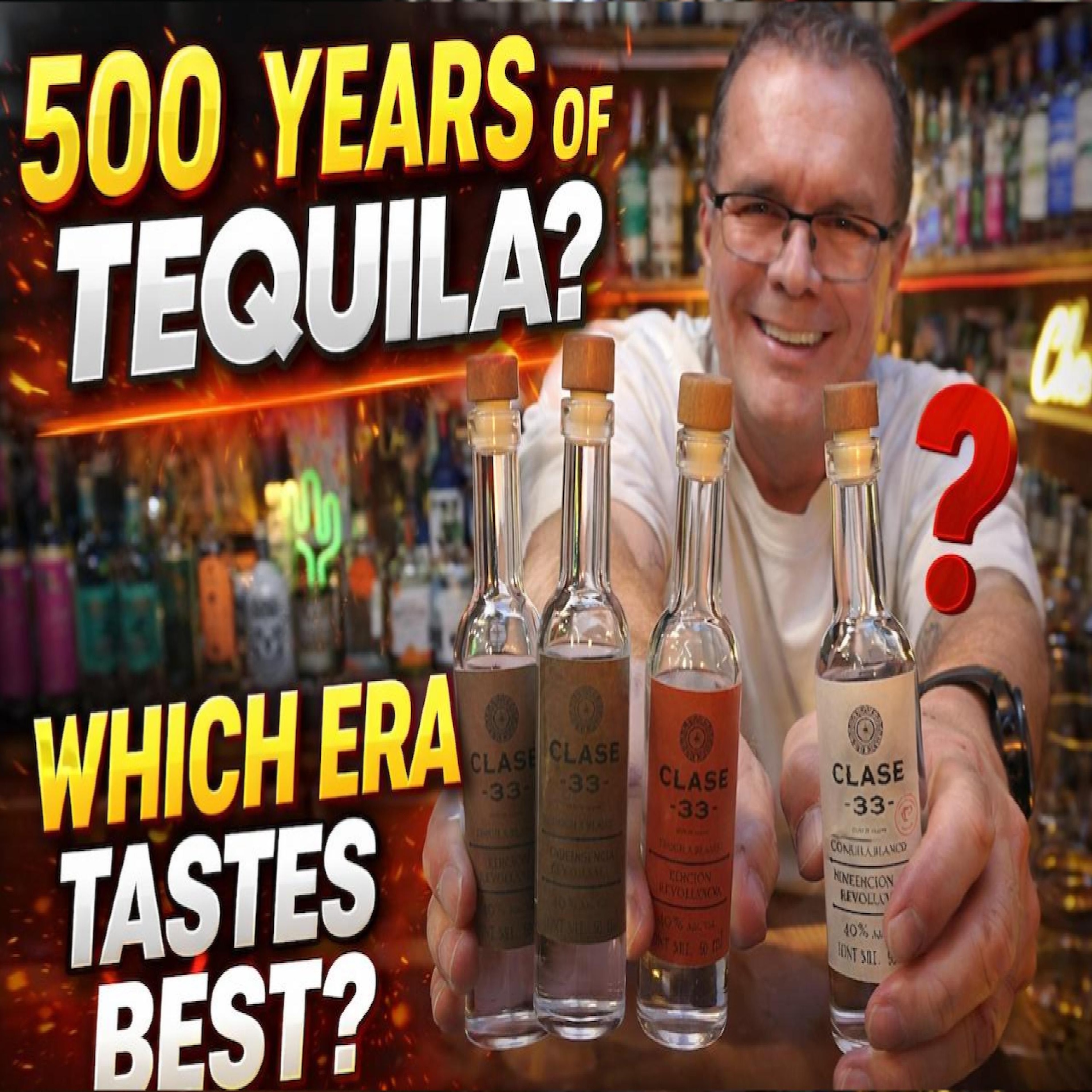
[00:00:00] All right, guys, today we're not just drinking tequila. We're going to drink through 500 years of Mexican history. I've never had this before. I don't know what to expect from class 33. They sent me these four different expressions. Each one is made with a completely different historical production method. Pre Hispanic conquest, independence, revolution and modern day. And the question is, does history actually change flavor? And which tastes the best to me? All right, guys. Well, here we were hanging out down in the town of Tequila, and I got to meet a guy named Keith who is at the Velor at Atanasio distillery with us. And he is a distributor and he represents this brand. And he brought me a shirt and these samples and asked me if I would taste through them and see what I thought. And this production is created by fifth generation producers Augustine and Mauricio Camarena, part of the 33 members of Agave producing families. And they did something bold. They started to chase innovation and they went backwards. So each one of these is going to come from a different production method. Horno in the ground oven cooked, they're going to use a canoe and crushing with a mallet. They're going to go from that process to fermenting in some old wood pine tanks. And from there they're going to do distillation in clay pots. Let's taste that one first. So let's pop this little sample open.
[00:01:23] Okay, so this one is your oldest method. Now I get a nice fruity note, almost like I would on a.
[00:01:32] A mezcal.
[00:01:34] There's a neat cooked agave. There's a subtle hint of smoke, and there's a nice like, funkiness to this one as well.
[00:01:43] All right, let's taste it.
[00:01:45] Nice mouth feel.
[00:01:47] I get a cooked agave, roasted a little smoky. I get almost a grape note. A lot of vegetal characteristics, a lot of herbs and veget vegetable notes. A little bit of like a celery, a little bit of like a grass, maybe even a little bit of like a lemongrass. So that, that's very interesting. The finish was kind of soft. It didn't hang on a really long time.
[00:02:10] It definitely goes right up that smoky iodine lifts in there with that agave and those vegetable notes. And that grape is definitely there. That's okay. That's. That's very interesting. So now we're going to go a few hundred years up. We're doing just a regular stone oven to hone a crush and then pine fermentation. And this is going to be a pure copper pot. Again, small. A small production method. Old production method, of course. Course. And this one is called the Independencia. So let's give this one a nose.
[00:02:43] Okay. Definitely no smoke. And the funkiness is amped up on this one.
[00:02:50] I got a paper here that gives a little more information about each one. So this. This should taste that of 200 years, the end of the Spanish rule. Lu Agave trijonicas, masonry, stone, oven. These are Los Altos agaves. So let's.
[00:03:06] That funkiness is nice. It's almost like a blue cheese funk with a cooked agave smell.
[00:03:14] Cooked agave, creamy mouth feel. It's a little weird bitterness there. Not sure what that's from. The. The vegetable notes are a little bit amped up, but there is a little more of a orange and citrus. That grassy note is still there, too, but is far more a citrus with grass. Almost like a orange with a little bit of hay and a little bit of lemon. I will say that I probably would drink this one more often because this smoke isn't something I'm a huge fan of. Again, it's subtle, but I picked it up a little more in that second taste. So the next one we're going to do, this is revolution. And this one is a more modern process. Right. We're going autoclave. They're going, I believe, high pressure, but it could be low pressure. They don't really say on anything. This is going through a roller mill. This is going to be stainless steel. Wild fermentation. And based on the picture, it looks like they're going with more of a newer still, like a probably stainless steel with copper coils or possibly a copper pot still. So let's dive into this one.
[00:04:13] Okay. A little bit less of the funk. A little bit more cooked agave, A little bit of orange. And there's a little bit of that funkiness there, that little cheesy note, just not as pronounced. All right, cheers. Let's try this one.
[00:04:26] This one is far softer. It has a lighter mouth feel. It has much more bright notes, much more bright citrus. Much more bright cooked agave. That bitterness is there. I don't feel like there's anything fake in these. I'm not picking up, like, any sweeteners or something that I would think not supposed to be there. There is a little bit of a bitter note that I'm not sure what that is not off putting. Almost like in this one, it's going to kind of remind me of like a cocoa bitter. Kind of pretty interesting.
[00:04:53] I'd probably lean more If I was going to sip, I'm going to sip one of these. If I was going to cocktail, I'd probably make less one of those. That was nice. That's got, it's really different. These two are more alike than these two. So that probably tells me that maybe they did do high pressure autoclave. It seems just like a little bit, a little more bitterness. The agave is much softer. It's still there. It's just different. So let's dive into this last one. This one worries me. Okay, so this one's diffuser, right? So that big giant machine that we talk about that doesn't really cook the agave, it just blasts it with water. From there, the goop goes into a post diffuser autoclave. It is then pressurized and cooked, usually only for a few hours. Then from there it's going to stainless steel tanks. Based on this, it looks like they're open tanks. I would think a lot of the places I've seen where the diffusers are is they're closed tanks. But this does show like an open tank in the picture. So I'm not sure the timing that they're doing in the fermentation or if they're adding like an accelerate yeast that they're not really saying a whole lot about the process, but usually they'd use a yeast that would accelerate the process and the time that it takes to go through fermentation. And, and then from there they're clearly going into a column still. So this is the production method that I'm probably the least excited about. I haven't found a diffuser tequila that I can use for anything. So let's dive into this one. No nose. There's like, I, I, I. This smells like nothing. I don't get any nose on it. If I, if I go really deep, really hard, I get a faint smell of tequila, a very faint agave note. So let's, let's give it a taste.
[00:06:28] I get a weird sweetness. I don't get any agave. I get a lot of pepper and there's a lot of a weird pepper that just kind of lights up and is warm in the finish. So an upfront sweetness and then pepper in the finish, not really any agave.
[00:06:42] So there you go. There's the four production methods. And for me, this solidifies the, of the production methods that I'm most comfortable with. And that would be, you know, the first three and probably leaning more in the second, second and third. I do like a low pressure autoclave better than a high pressure autoclave. I believe it brings out more cooked agave flavor than what it does in this process here. So guys, for what you're doing and what you're trying to put together here, this is pretty cool. Mauricio, I'd love to come visit the distillery and check it out. Really cool presentation. I think this is a pretty neat thing to watch. Hopefully you enjoyed it. If you have anything to say about these different production methods, leave me a comment. Put a comment in there and talk about the different production methods, what you would like the best. And if you like learning about tequila and you like these videos, hit that like button, that share button, subscribe button. Again, thanks for watching my videos and Cheers. Subscribe.