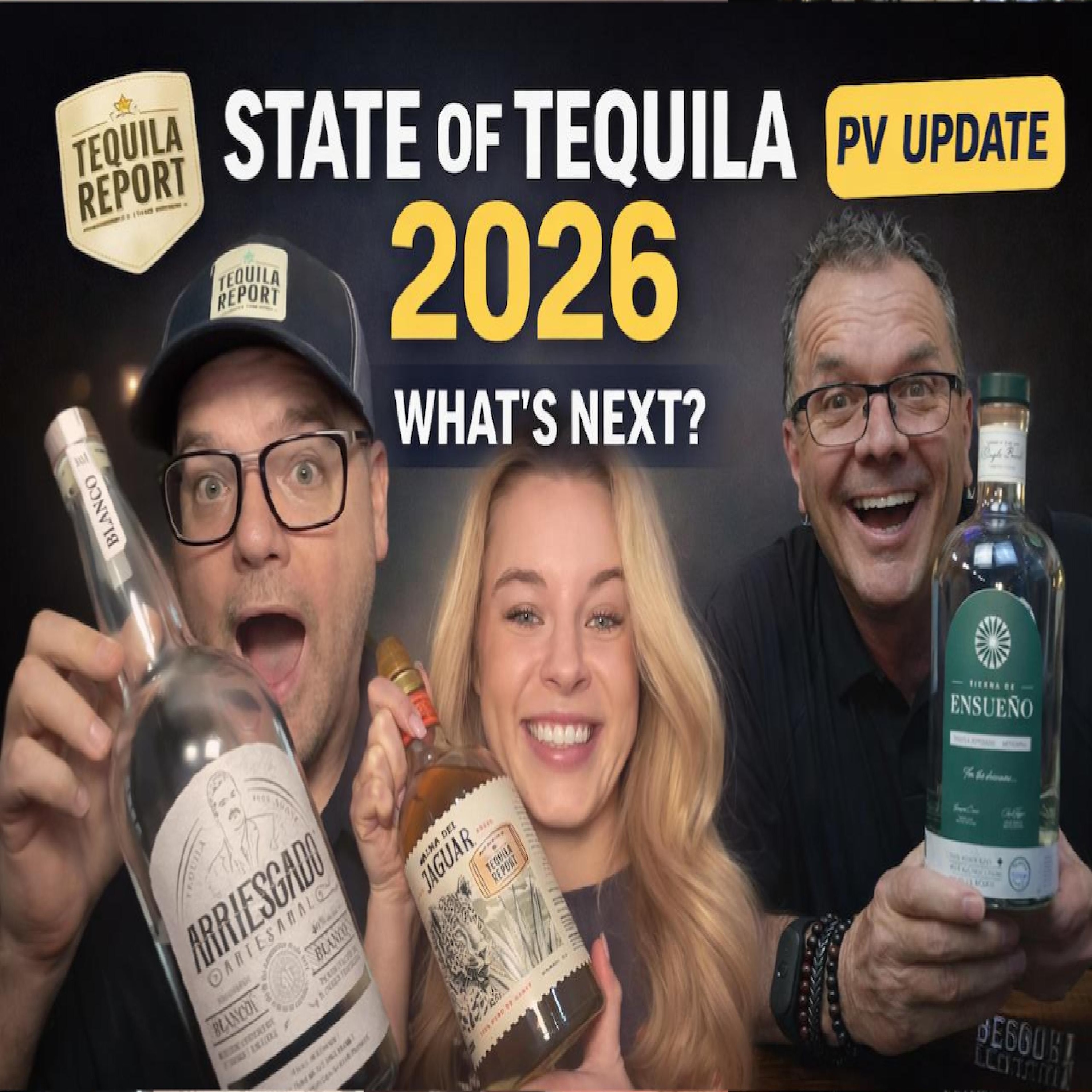
[00:00:00] Speaker A: Tonight you're going to find out the current state of tequila and also what is currently happening in Puerto Vallarta. So today we're going to have Tequila J Bear on and Matty Jagger, and we're going to talk about the Tequila Report, a new report that they have out about the state of the tequila industry. And he's going to give us a little update on what's happening at his home there in Puerto Vallarta. So stick around. This one is packed full of information.
[00:00:26] Speaker B: It's tasting tequila with bread.
[00:00:36] Speaker A: All right, guys, I am fired up to be here with two of my favorite people from the Tequila Report, Jay Bear and Maddie Jagger. How you guys doing tonight?
[00:00:46] Speaker B: We're good, buddy. I know that Maddie is one of your favorite people and I'm just here, but I appreciate that.
[00:00:52] Speaker A: Well, you've been a big help for me from day one, watching your videos before I ever started doing this, and all of the advice that you've always given. You've been very helpful. So I do appreciate you very much.
[00:01:03] Speaker B: Thank you so much. Our pleasure. Great to be with you. Tasting tequila with Brad. What are you tasting?
[00:01:09] Speaker A: I'm having the Batch 2 Reposado rum casts in Sueno.
[00:01:15] Speaker B: Oh, fantastic. We actually are having a conversation with Matt and Oscar from Ensueno as part of the Tequila Report insiders group on. When is that, Maddie? Tomorrow. Thursday.
[00:01:26] Speaker C: Tomorrow. Yep.
[00:01:27] Speaker A: Yeah, so when this comes out, it'll be yesterday.
[00:01:29] Speaker B: Yeah, exactly.
Tune in next time.
[00:01:33] Speaker A: I'm actually excited about it. I'm going to try to jump on there for a little while, so, yeah, I'm pretty excited.
[00:01:39] Speaker C: Should be good. I've got the brand new Alma Tequila report.
You know, special project that we did with them.
Just came to my door about an hour ago, so I poured myself lots of that fresh.
[00:01:58] Speaker A: Awesome.
[00:01:59] Speaker B: The Arias Gato. This is the 40% kind of Mexican, lower strength version. I think a lot of the new releases are going to be a little bit higher proof than this, but this is a delightful bottle. Has a little hint of smoke to it because the way they. Because the way they make it.
[00:02:13] Speaker A: Yeah. And if you want to check out how that's made, you know, go scroll through some of my videos. I got to do an interview with Roberto Rio and he explained that whole process. It is fantastic.
[00:02:24] Speaker B: Did you get a chance to visit the distillery when you were there?
[00:02:26] Speaker A: I have not, no. We.
We wanted to this last trip, but there were so many. You know how it is when you go in there. You got so many places back to back to back. We didn't get a chance to. So knowing that you're there now in Puerto Vallarta, and this is going to be a video that comes out pretty timely. Tell us about what's going on today and just. Just how crazy it got while you were there.
[00:02:49] Speaker B: Yeah, things are chill today. It feels like a normal day for the most part. School's not in session yet, but pretty much everything else is rolling here, which is great. It was definitely a little harrowing on Sunday. 200 cars were carjacked and burned.
About 50 stores were burned. They busted 28 guys out of prison. It was a little crazy there for a while. And none of the emergency vehicles could get into town because it was all blockaded. So all the fires just burned until they had nothing left to burn. So air quality got pretty bad there for a while. But then eventually in the mid afternoon, the army showed up and were able to kind of take back control.
So since then it's been pretty quiet, but everybody's sort of, you know, like, okay, well, that happened. That was exciting. And now everything is sort of snapping back like it usually does here in Mallarta. But everybody's sort of got one eye open a little bit, I'd say.
I bet.
[00:03:39] Speaker A: I know it was really scary for all of us at home knowing all of you guys that were there, all of our friends that were there, and a couple of groups that we knew were traveling. So it was good that you were giving some updates. And the thing was, it really wasn't on the news there here until today and yesterday. So when it was happening, you know, nobody really knew what was going on.
[00:03:59] Speaker B: Well, I mean, there wasn't really even any news here other than just individual Facebook posts and, and tweets and stuff, because there was just no ability to get around the city and, and everybody was kind of staying inside just out of abundance of caution. So there really wasn't much media coverage even in Mexico for. For a while, which always makes it a little bit more uneasy when you don't really know what's going on. But I've been trying to keep people up to date on Facebook and Instagram and Twitter. In fact, I got. I put a Facebook post out that got now 13 million views so far. And so I've been doing a lot of press in the last couple days.
Yahoo. Six or seven. Radio interviews, newspapers, TV stations, et cetera. So it's been nice to sort of be a voice of reason for people who are not really sure what's going on.
[00:04:41] Speaker A: Yeah, I've had some friends reach out. Like, should I cancel my spring break trip to Cancun? And my answer is, did you cancel your spring break trip to Fort Myers when there was a riot in Minnesota? No.
[00:04:54] Speaker B: Yeah.
[00:04:55] Speaker A: Cancun's 3,000 miles away from where this happened, so, yeah.
[00:04:59] Speaker B: Yeah.
[00:04:59] Speaker A: I mean, it's.
[00:05:00] Speaker B: You know, it is, as I said earlier today to somebody, you should probably come. But it would be foolish to pretend like nothing has happened or nothing could ever happen. What was interesting and different about this particular experience is that, you know, there was simultaneous violence in 20 Mexican states, which is roughly the size of Western Europe. That level of coordination is kind of unprecedented here and a little bit unsettling.
So it will almost assuredly be fine when you're here. But, you know, you should always know that things can happen before you get here. Things can happen when you get here. I mean, Maddie and I have been here dozens of times. You've been here tons of times, have never had anything happen other than than occurred a couple days ago. And don't expect anything to happen again. But, you know, all travel to anywhere in the world carries some degree of risk, and you should always be mindful of that.
[00:05:50] Speaker A: Yep, 100%. No, I agree. I always say stupid people win stupid prizes for doing stupid tricks. So if you're going somewhere, don't do anything stupid.
[00:05:58] Speaker B: Yeah. I mean, you can get. You can get norovirus on a cruise ship, right? I mean. Yeah, you can. You never know. You never know.
[00:06:05] Speaker A: Well, I've been really excited about the Tequila Report. I know we got some really cool stuff coming out and lots of great issues so far.
Let's talk about the report that we have to talk about today.
[00:06:18] Speaker B: Yeah. So Tequila Report itself, as a publication, of course, is an online magazine and newsletter for tequila lovers. The website tequilareport.com is always up, and then we do an email project as well.
[00:06:28] Speaker C: Yeah. Well, I was going to say it's kind of funny because there is a misconception, a little bit, that Tequila Report is like one report. And I think people didn't quite understand that when we first launched it. And now, obviously, we're here to talk about a report that we've published, but, you know, kind of separate. Separate things. So we do have an email that goes out every other Tuesday evening. We've got 50,000 subscribers already. If you're not subscribed, subscribe at tequila report.com/subscribe.
And then we have social media posts that kind of go along with that. And we also have once a week an email that goes out that one of our partner brands helps us send. And so we're just really out here promoting great tequila and great people that, that make it.
[00:07:14] Speaker B: It's been really fun to work on and still is. And we love the reviews that you're writing and lots of other friends of, of the publication. And then we do a lot of long form interviews as well. So in this current issue we've got a long, long interview with Jesse Estes at Tequila Ocho. All about the changes at Ocho, moving to the Terroir select program and, and making some of the tequila. Now back at La Altena we've got a long piece on the mules at Siete Legua. So they're the only distillery that still uses mules to, to pull the Tahona. We've got some research excerpts. We've got an interview coming up with the organizers from Arte Agave. We've got a long interview soon with my colleague from about their history and founding. So every, every issue's got a whole bunch of content and up to date events calendar as well. So it's a lot of stuff when, when people visit the website for the first time they can't believe how much is on there.
And that's, that's kind of what we're looking for.
[00:08:03] Speaker A: Yeah, it can be overwhelming when you go to think oh, I'm just going to go read this story and then it's, it's better than doom scrolling two hours later. You've read horror stories.
[00:08:14] Speaker B: Boo scrolling.
[00:08:15] Speaker A: Yeah, exactly. So I, I've been, I've gone to it and read through articles and then gone back through some of the articles as well. I was telling Maddie before we come on here, I said man, I wish I could write something like I'm not a writer. I am, I can stand in front of a group of people and speak. But if I got to write it down, it's where I turn into my dyslexic six year old.
So. But I love reading the articles and it's really cool. It's great to be a part of it.
[00:08:40] Speaker B: Thanks. And then as Matty said, it's not really a report, it's a magazine. We're going to call it the Tequila Magazine but that seemed too boring.
So the Tequila Report has a report.
I'll show you a picture of it. It looks like this.
This is a huge 29 page research project that we put together called Only the differentiated survive the six trends shaping tequila in 2026. So we did a whole bunch of research.
First party research of our mailing list of 50,000 people. We had 1200 participants in a very detailed survey. We augmented that research with data from Nielsen and a lot of other sources to kind of look at what's really happening in the tequila business, where it's headed, what's going to happen next, et cetera. Because as you well know, Brad, it's an industry that is in a state of flux.
And a lot of changes are happening right now, sort of like a new stage of the tequila business. And so we wanted to capture that in this report. And so far, lots and lots of brands have been really interested in it because it speaks right, to what they need to do to survive and thrive.
[00:09:49] Speaker A: What are some of those things that brands need to do today?
[00:09:52] Speaker B: Well, one of the things that was most interesting in the research, and we sort of lead the document with this, is that there really isn't one tequila market the way there used to be. And when we talked about the tequila business, for purposes of this conversation and the research, we're really talking about the United States tequila market. We're not talking so much about Europe, we're not talking so much about Mexico, but really just the United States market. And in the US it's not just a homogenous tequila buyer's market the way it maybe has been historically. What we found in the research is that there's kind of two markets now.
There's a. There's a much larger market that. That doesn't necessarily care a whole bunch about what they're drinking and who makes it and how they make it and what it costs. They're like, I'm want a margarita at a Mexican food restaurant, or I'm just gonna get whatever house margarita they offer, probably frozen or. Or whatever. It's just not a lot of intentionality into their purchases. And that's. And that is the lion's share of the business, Mattie. I mean, that's. You know, the top 20 brands are. I forget what percentage we. We looked it up. It was 80% or something. Of all tequila sold is in the top 10 brands or something crazy like that. So it's very concentrated.
But then there's this whole other group of consumers that are very much paying attention to what they're drinking and who makes it and how it's made. People who watch this program and. And other content creators and different guises and forms and. And they want all the information, right? They want to know who made it and how it was made and what. What it was made with, and does it have avocantes and where Were the agaves grown and, and what were the level and all these kind of things. And so that group is also growing. So what we find, and to us this is sort of good news is that the tequila market overall in the United States, right. So all tequila total is down one and a half percent in sales in the last year for 2025 calendar down to a percent. But we would, what we would call Kraft Tequila, which we loosely define as the brands that are listed as, as brand partners on agave matchmaker so thought to be additive free. And that's 120 brands, something like that. At this point, that group grew in sales by like 28%.
So the category flat to down craft brands. And again I'm using that term with air quotes because it's not defined necessarily. But I think when I say craft, most people know what we mean.
Craft brands up, you know, almost 30 points.
So it's a big split in, in the market. Now the craft business is still, you know, 8 or 9% of the total tequila market. So it is quite small.
But the fact that there is a growing group of consumers who, who care about these issues I think is good news for smaller brands. And you see bigger brands and even governing bodies like the CRT trying to push back against these conversations, which, which I think proves that it's working.
[00:12:46] Speaker A: Yeah, I like some of the websites out there that are telling us, you know, additives don't, don't matter and production doesn't matter. There's a couple of new sites that I've seen here recently. We were talking one of the reports.
It's, it's pretty crazy what they're trying to push. And I think the, the consumer that, that we're talking about is educated enough to want to dive in and get more information.
And isn't that casual consumer like the one that just wants the margarita?
[00:13:14] Speaker B: Yeah, exactly.
[00:13:16] Speaker A: You know, we're, we're starting to see some brands reduce some pricing. We're starting to see some brands that are coming out at a different price point. Even, even brands like Lost Lore that have now released this new on premise product that is to hit a lower price point. Do you think we're going to continue to see a shift in price point of tequila and people going after more of that lower price point to get that regular buyer.
[00:13:43] Speaker B: Well, Maddie, we saw in the research, right. That price, there is a threshold, right?
[00:13:47] Speaker C: Yeah, there's a pretty, pretty strict threshold for blanco. I think it's like what percent, like 85% or something will pay up to $55 a bottle and then for reposado, same sort of thing, but $65 a bottle. And then there's like a drastic drop off for both of those.
So I think brands are starting to realize that, you know, 55 might be kind of the, the upper echelon.
[00:14:22] Speaker B: And I don't know that you're going to see like huge price cuts. But certainly at scale, some of the bigger brands are already getting less expensive. Lalo's less expensive than ever. Ocho is less expensive than ever. G4 is less expensive than ever. I mean, they're at a scale now where they can take a lower margin per bottle and make it up in volume. And that just kind of puts downward pressure on some of the other craft brands. And that's not to say that you can't sell a hundred dollar bottle of tequila. You can, but. But people are only going to buy so many of those. Like at some point they're going to tap out. Right. Unless they're you or us who do this for a living. And this is like your jam. Yeah, there is a group of people like that, but it's not that many people in the big scheme of things.
[00:15:03] Speaker A: Right.
[00:15:03] Speaker B: So we find it's interesting that, that even amongst kind of your core tequila audience, who mostly are $200,000 and up household income in our research, so it's a, it's a pretty well off audience even. That group doesn't tend to buy that many new bottles or even try that many new tequilas. The average kind of core tequila fan will try maybe two, three new tequilas a month, period. Right. So I know that's like an afternoon for you, Brad, but for, but for mortals, it's a, it's, it's a whole, it's a whole month worth.
[00:15:38] Speaker A: Well, I do get to try a lot of new tequilas. I agree.
One of the things I think I've seen, you may agree that Zoom Ador, I think has really changed the market a little bit in such a quality product at such a low price.
But in this same breath, we just seen a house of rare blanco at almost $200. Right. So even though you see some changes, you still see these special bottles. Right? I don't think a $200 bottle of Blanco is going to fly all the time.
[00:16:10] Speaker B: No, but it's obvious as it did. It's not the same business strategy. Right. So both can coexist. Neither really impacts the other in any meaningful way. Zumador is trying to do a high volume, low margin business. Their margin is Helped by the fact that it's vertically integrated, right? They own the distillery, they own the agave, they own everything, right? So they're not. They're not paying people off to the side to do things, which allows them to do it less expensively.
And. And House of Rare is literally the exact opposite, right? They're making small batch. They don't own the distillery, they don't own the agave.
And. And could House of Rare sell that bottle for 60? Of course they could, but the fact that it's 200 is part of the marketing. It's not. It's not a structural cost for them.
I mean, look at. Look at Clas Azul. Look at Casa Dragones. Look at any bottle that's, you know, in that price point. At some level, it's expensive as a marketing. As a marketing hook, which I know is a paradox, right? Like, I want to buy it because it's expensive. Seems a little bit absurd to people who really know tequila, but it definitely works. Like, I know a lot of people who say, I love tequila. I know all about it, and all they drink is class Azul. So I. I beg to differ.
[00:17:15] Speaker C: I get a lot of texts from people. The, like, with the bottle, they're like, do you know this one? It's my favorite.
Yeah, yeah, sure.
[00:17:24] Speaker A: Do it.
There's a reason why Rolex brings in more money than Timex, right?
[00:17:29] Speaker B: Yeah.
[00:17:30] Speaker A: They both tell Time. They both do the same thing.
[00:17:33] Speaker B: Yeah. What I think is interesting on this point, though, is brands that have been more expensive and are getting less expensive. Probably the best example is Gazganes, right? So they. They redid some of their operations and dropped their price, you know, 10, $20 a bottle across all lines. That, to me, sort of is the. Is the trend, right? Like, you can still be luxury. You can still be expensive and be a little less expensive. And so that's. That's what I think. That's what I think. We'll see. Because people have got to be smart. Like, look, you know, this Idea that there's 2,000, 3,000 tequila brands is not actually true. We talk about this a lot in. In the research. Again, you can get
[email protected] this idea that there's 3,000 brands, like, there's 3,000 trademarks that have been registered.
So do those brands exist? Well, sure, but that's like saying a guy once played major league baseball, therefore he's a major league baseball player. Like, yes, but not today.
So a lot of those brands existed at one point. Don't exist today. So we did a lot of research and analysis on this and found that there's approximately 900 brands, like Real brands that you could buy in a store in the U.S. that's like the true number, about 900. Now. That's still a lot. Like, don't get me wrong, 900 competitors is still a lot of competitors. Like, if there's 900 mortgage guys in Indianapolis, you'd have less tequila. Like, there's like, it's still a competitive business, don't get me wrong. But it's not like, as crazy as people have said.
But because of this pressure, right? People are drinking less. Like that. That is. That is true fact. Right? Like. Like the number of people who drink in the United States is 54%, which is the lowest it's been in like decades. Like decades, right? So people are drinking less, there's a lot of competitors, and, and some of these craft brands are not going to make it, period. Like, Maddie and I talk about this all the time. Right, Maddie?
[00:19:24] Speaker C: Yep. Yeah. Yeah. I mean, I think there's going to be a big shakeout in the market in the next, I don't know, two, three years.
And we're, I mean, we're already seeing it happen.
[00:19:36] Speaker B: The problem is a lot of these brands aren't that big. Right. You know, you know, because you're working with a lot of brands out there. It's not very big. I mean, they're not. They're as businesses, right? They make great tequila, but they're very small businesses. And I think this is something that a lot of tequila consumers don't understand. Because I've had interactions with people on Facebook and Reddit and places where they're like, well, yeah, they should just like, do more advertising or open up more states. I'm like, you don't understand, man. Like, like, these are like, in many cases, three, four person businesses, like the dry cleaner on the corner of your street is a bigger business from revenues perspective than many of the craftyquila brands we know and love. Like, these are truly mom and pop businesses. And, and they, you know, they just don't have a ton of capital in
[00:20:19] Speaker A: many cases, and so much cost sitting in inventory before the product even gets here. And then if you own the dry cleaners across the street, at least you can open up and sell your service. They don't have to find an importer and then a distributor and then a retailer. And people don't understand that there's a lot of hands in the pot. But when you go into a Liquor store, there's not room for 900 bottles on the shelf. So you're also fighting for the shelf space.
And then when you walk into a liquor store, it's not like a concierge service where they're walking you over to pick out the suit that you're looking for in Nordstrom's. It's just a liquor store guy that's waiting to go outside and smoke a cigarette, hoping you pick something off the shelf and get the hell out of the store. So it's such a brutal business to be in because you don't get to sell your product, you have to make somebody else sell it. And in that, I've talked to a lot of brands recently that have shifted from an importer and are now self importing to kind of help squeeze that margin. Do you think that's going to be a trend where brands start doing more self importing and leaving some of these
[00:21:23] Speaker B: importers, I think brands want to, and then they realize how hard it actually is. Like, there's a lot, I mean, yes, you can do it, but you have to have a person do it. And so then you, you're basically trading your importer markup for, for a salary or you're doing it yourself at night or whatever. Like it's a lot of paperwork, it's a lot of hassle.
So it's certainly possible. But it's not like, it's not like, leave your importer free money, it's leave your importer and now your life sucks
[00:21:49] Speaker A: worse at a job.
[00:21:52] Speaker B: Yeah, yeah, exactly. So I think it's possible and we probably will see some of it.
You know, you're starting to see more brands get more and more serious about, about direct to consumer as well, trying to sell through the Internet. And you know, we've done other research in the past that shows that, you know, consumers are relatively willing to buy tequila online, especially nerds who really love it. But, but other people aren't, right? They're like, ah, yeah, I could buy it online, but I'll just go down to my store and whatever they have is close enough because I don't want to spend 15 for shipping and wait for a week, which, you know, it's a go go world. Like, I understand that philosophy. Like, I, I'm thirsted now. Like, you know, so I get what people are coming from sometimes. Yeah, yeah. Most people don't have a whole store in their house like you, so they can't just be like, well, this is what I would, you know, Well, I,
[00:22:44] Speaker A: I order a Lot still, too. And. And I do order brands that aren't in Indiana. Right. So I. I do a lot of online ordering. But like you said, the casual drinker that just wants a margarita isn't turning to a website to order tequila. They really got to be impressed with what's going on.
Do you think we have more of the bourbon bros coming over to tequila and learning a whole new spirit and kind of stopping the.
The crazy bourbon hoarding that's been going on for years?
[00:23:17] Speaker B: Yes.
I mean, we. We. We looked at that in the research, and we found that we asked people, when you're not drinking tequila, what. What do drink?
And the number one answer was Maddie.
[00:23:31] Speaker C: Yeah, it was bourbon was bourbon, and
[00:23:33] Speaker B: number two was beer. Yeah, yeah. Second was beer. I mean, Mattie's husband's a good example, right. He's always been a whiskey bourbon bro, and now Matty has convinced him to enter the world of tequila, and he's buying less bourbon and more tequila. Does that mean that the bourbon kind of mania has subsided? I don't actually know because I'm not in that community. I can't say somebody like Wayne would be a good one to ask who's got a foot in both camps, you know, Wayne from Cascanas, whether the temperature is, you know, chilling out in bourbon as it. As it gets more hot in tequila. That stands to reason, but I don't know that that's true.
[00:24:13] Speaker A: I've had a couple stores that I've been in that have said, you know, our tequila selection has grown. Our scotch selection is almost gone, and there's now bottles of E H Taylor that they were allocating that now you can get, you know, E H Taylor. You can find Buffalo Trace that was allocated for a while. I was in a store the other day that they had Blanton's on the shelf, so.
[00:24:37] Speaker C: Wow.
[00:24:38] Speaker A: At retail? Yeah, I think they added. I mean, over high retail, it's a 60 bottle for a hundred bucks. But when you go into stores and it's actually there, you think, okay, well, something must be slowing down, or they just made so much that now it's available.
[00:24:55] Speaker B: There are some truth to that in tequila too, right? There's a lot of tequila and tanks right now, mostly the big brands. The small brands know, because they.
[00:25:02] Speaker A: They.
[00:25:02] Speaker B: The distillers are small or they make a lot of brands, right. So they don't have the kind of tank storage space. But for the big brands, you know, the top 20 brands, they have a lot of tequila in steel just waiting or barrels and that is going to allow them to kind of keep prices low. You know, I think their plan is, as things kind of flatten out in tequila business, to try and win on price and try and make this whole additive free conversation go away and keep prices low is like, well, yeah, you could get lost lore for 65 or you could get Teremona for 22. Is it three times better like that? To me, that's the business strategy that I see unfolding. And that's why education and differentiation is so important. As we talked about in this, in this research, as Matty said, some of these brands aren't going to make it. And the ones that are going to make it are the ones that have an actual distinct narrative and story.
[00:25:51] Speaker A: Right.
[00:25:51] Speaker B: There is something about that brand that you can say and remember very quickly that allows you to distinguish it in this sea of even sea of craft brands. I mean, there's hundreds of craft brands, even a couple hundred at least. And, and so those are the brands that, that I think are gonna, are gonna survive and thrive are the ones that you can say, oh, those are the guys that blank. Whatever. Whatever blank is. Right. And, and we talked about this in the report that this is why celebrity tequila works.
It's because it's a shortcut for the retailer, it's a shortcut for the bartender, and it's a shortcut for the consumer. You don't have to remember who makes it, where it's made, how it's made. You have to remember this tequila is owned by somebody whose movie I liked.
And while that might seem ridiculous just as a, as a, as a sifting and sorting device, it's very useful.
[00:26:41] Speaker A: Right?
[00:26:41] Speaker B: It's, it's like the Harry Potter sorting hat. Like, that's how people make decisions in a store.
You look and you're like, okay, bottle, bottle, bottle, bottle, bottle. This one. Because I remembered a thing about it.
And this is the problem with a lot of these smaller brands. They're all trying to sing the same story, which is, well, we make it without additives and we make it in an artisanal way. And we've got this famous master distiller, or we make it a good distillery that differentiates you from the big guys, but it doesn't differentiate you from all the rest of the small guys. And so people have to be smarter and sharper about their messaging to break through.
[00:27:16] Speaker A: Yeah, creating that true story of what the brand really is about, not just where it's made. I mean, that part's important.
You know, a lot of people Rag on celebrity tequilas. And I love it when they do it standing in their Jordan tennis shoes.
[00:27:32] Speaker B: Well said.
[00:27:33] Speaker A: Like, we've been buying celebrity crap, you know, from before Jordan made tennis shoes. So for it to be surprising that, you know, we buy Ryan Reynolds gin or we go get McConaughey's tequila or is bourbon. Right. They, they all have multiple brands, you
[00:27:51] Speaker B: know, Maddie's Bourbon, for that matter. Maddie's Tequila.
[00:27:55] Speaker C: Yeah. My tequila. Well, I think also, there's also a notion that all celebrity tequila is horrible and it's not. You know, there's some good brands.
[00:28:05] Speaker A: Right.
[00:28:05] Speaker C: So you kind of feel bad for those brands that, that get that bad rap. Like, I mean, we really love Insolito.
[00:28:12] Speaker A: Yep.
[00:28:12] Speaker C: It's great.
[00:28:13] Speaker B: Excellent. Right?
[00:28:14] Speaker C: Great. Juan Lobo. Great.
[00:28:16] Speaker B: Juan Lobo. El Bandido. The guys at Dos Ompres are doing a new tequila coming out soon. Bryan Cranston and Aaron Paul. They've got a new tequila project coming out. Made it what used to be called ttap where, where cascanis and pantalones has made. They've got a new project coming out soon. That's, that's, you know, looks like it's going to be really good.
So. Yeah, it doesn't, you know, celebrity doesn't mean bad. Now there are a lot of celebrity tequilas that are not particularly well made. That is factually correct.
But to say all. I see this all the time in comments, all celebrity tequila is bad. It's like, no, that's, that's not, that's not fair.
[00:28:48] Speaker A: Yeah, I agree. And I did just hear not too long ago that McConaughey's Tequila Pantalones, which is also made at TTAP, has now agreed to change the way they're going to do their production to an additive free product. So that'll be good to see. We'll see if it is. All right, all right, all right. When it comes out.
[00:29:06] Speaker B: Well, we should, I know we just reviewed it recently on the tequila report. We should check the lot number and then review it again and, and see if we can taste the difference.
[00:29:15] Speaker C: Yeah. Do a side by side.
[00:29:18] Speaker A: And I think that's important for a brand like that. You know, Cascanes, who's made there, you know, who has a really clean production, kind of got hit on the Internet by somebody testing it and having trace amounts show up in their tequila. And now my comment was it looks like the pantalones got in the cascanes.
So knowing that now the, maybe the distillery is going to make some changes that they just can't Produce something like that would be good.
[00:29:43] Speaker B: Absolutely. And it's, I mean it's challenging for big producers like, like those distilleries that make a lot of brands, keeping all the equipment clean and separate and all that. It's, it's, it's a real challenge.
That's why there's, you know, a lot of the kind of quote, quote unquote, additive free brands are made at distilleries that are, that are universally. So there's not too many where, where you have distilleries that, that make mostly tequila with Avocantes and then a few brands that are, that are free that it definitely makes the production a lot more complicated. Yeah.
[00:30:10] Speaker A: To think a brand like Nosotros has survived at a distillery where they've been and keep such a clean product and such a good production method for when they do it, it's pretty impressive.
[00:30:21] Speaker B: Although, breaking news, they're changing distilleries, so.
[00:30:23] Speaker A: Yeah, he said that in the interview I just did with Cardiff.
[00:30:26] Speaker B: Yeah, I know. I thought you saw it. Yeah. So, uh, it'll be, I can't wait to, to try the, the new, the new batches from them. It's going to be great. I like their new packaging too. Um, I want to just mention something that we, that we found in the research that touches on a thing that you mentioned a minute ago, Brad, that, that, you know, the, the guy in the retail store isn't necessarily ready to help or, or knowledgeable about the category. I think that's sometimes true, sometimes not true. Yeah, but what we found in the research is that most consumers don't actually want that help. So we asked people, and again, we had like 1200 responses. In all 50 US states.
When you go to a retail store, which of these things might influence your tequila purchase decision?
56% of people said nothing. I go into the store knowing what I'm going to buy. More than half.
Three in ten people said that a recommendation from a store employee would help, which means that 7 in 10 say it wouldn't.
About 3 in 10 say some kind of signage, like 95 points on tequila report or won these kind of medals or whatever. Some kind of a shelf talker, as we call it, the business, something like that would, would, would help them.
20% say a discount or a coupon would entice them.
20% say a free sample in the store might entice them.
And that's about it. Right. So, so we found that really interesting when Mattie and I did the research that most people are like, I need to get lost. Lower. So I'm going to get some more lost. Lor not. I'm going to the store. What should I buy? And I find that interesting. And we actually asked that same question set about people going to a bar or restaurant. And the answers were even more pronounced. It was like 70 plus percent of people who go into a bar and are going to order something where you're making a choice, you're making a call.
Yeah, 79%, 79% already know what they're going to order in a bar. So this idea that the bartender is going to seduce you, I don't know that that necessarily actually happens in the world as much as bartenders would want you to believe.
[00:32:29] Speaker A: Wow. Where I'm the one that goes to the bar, looks at their whole list and then says, if all you have is those, I'll have a glass of water.
[00:32:38] Speaker B: Exactly. Yeah. Yeah. Gumbo head seems pretty good right about now.
[00:32:41] Speaker A: That's crazy. Yeah, I, I see that. Doing tastings in stores, like it's something else. Somebody will come in, ask questions, get a taste, say they like it, walk over, grab something completely different off the shelf and walk out the door.
But then there are those, you know, people that come to a tasting and then actually ask a lot of questions and pick up a bottle. But I, I look at that and go, if you're not there doing that tasting, they're coming in there to get what they came to get. Like, I, I can see people doing that.
[00:33:11] Speaker B: Yes.
[00:33:11] Speaker C: Often just like walk into the liquor store without any sort of plan, you know, like, you go, people are busy. Like, you go in and you go and you get what's on your list.
[00:33:25] Speaker A: I'll see a liquor store I haven't seen before. And I go in there just to look at their, their selection.
[00:33:29] Speaker B: Like, yeah, they might have something rare in there. You don't know. You might have some sort of dusties
[00:33:33] Speaker A: trying to find something that. I found two old Ultimo Agaves the other day and. Oh, really?
[00:33:40] Speaker B: Wow.
[00:33:40] Speaker A: Like 2011 Ultim guys. And I, I bought them and I'm going to do a video and taste the new one side by side of the old one. I was fired up and the guy looked at me and he goes, do you know what that is? And I'm like, yeah.
[00:33:53] Speaker B: So he was probably really excited to get that off the books after 16 years.
[00:33:59] Speaker A: It was at Noble Wine and Spirits in Bartersville. And he was like, I don't know anything about it. And I. So I, of course, spent 30 minutes telling him the whole story about Eliana.
[00:34:10] Speaker B: Yeah.
[00:34:11] Speaker A: Distillery. So, yeah, it's pretty neat. I. I love going to liquor stores, so maybe I'm the weirdo in the group.
[00:34:17] Speaker B: Did you get my. Did you get my little taste?
[00:34:19] Speaker A: We didn't open it there. I wanted to wait and you got
[00:34:22] Speaker B: to go back and help them.
[00:34:23] Speaker A: I sent a message to Ileana and she's like, oh my gosh. You got that? And it's like, tell me how it tastes. So I figured I'd do it.
[00:34:30] Speaker B: Yeah. She wasn't even making it then, I don't think.
[00:34:32] Speaker A: No, that was. I think her dad that was making it at that point.
[00:34:35] Speaker B: Yeah, I assume so.
[00:34:36] Speaker A: Yeah.
[00:34:37] Speaker B: So yeah, this would be great.
Yeah, that's a fun.
[00:34:40] Speaker A: You guys, when you guys worked on this and you were doing all the research, what do you think the most shocking thing that you learned from the research that you did?
[00:34:50] Speaker B: Most shocking. You know, there's a lot of shocking things in this research, but that's why we did it. Probably the first thing we talked about, right. Like it's pretty stark. Like I think we all have an intuition that the smaller craft brands are growing disproportionate to the big brands. But to say you're flat or down versus 28%, I mean that's a big difference. A really, really big difference. And so that was probably the one. Just to have that in mathematical form and not just gut feel I think is really important for the industry and pretty powerful. But you know, there's a lot of stuff in it's 29 page research. Right. Like there's a lot of stuff in here. We're really proud of it. We work for really hard on it. And when we say there's nothing like this in the entire industry, we mean that sincerely. Like Nielsen discuss Park street. Like it just doesn't exist anywhere.
It's only from Tequila Report. So we'll keep. We'll keep doing that kind of stuff. Also, some exciting news for you, Brad and other Tequila Report reviewers. I think we are finalizing a deal. So all the Tequila Report scores will be at Total Wine.
[00:35:56] Speaker A: Oh, wow. That's awesome. I was going to ask you if we were going to come up with some kind of shelf talkers that can go with brands for stores.
[00:36:03] Speaker B: So that'd be pretty cool actually. Maddie and our team, you know our intern Lexi, we send shelf talker graphics to all the brands who get high, high score reviews in Tequila Report for them to use on their own. Shelf talkers, etc. That kind of thing takes a while to Propagate. But they all have the graphics and all that and all that.
[00:36:20] Speaker C: We send them the little like medallion with the score. Originally our plan was to like we had, you know, created a graphic, a shelf talker that brands could use and then we're like, nobody's going to use this. Like they all want to use their own marketing, they want to use their own fonts and their own photos and so now we just send the little, little medallion. But we've seen several already included, you know, in their social media graphics and on their website. On their websites. Yeah. So we're excited about where that could go.
[00:36:49] Speaker A: That's very cool. That's, that's really exciting to know that the, the industry is embracing it especially with so much information that's available.
That's I kind of expected on my side. I, I think they would all love it.
[00:37:03] Speaker B: Yeah. And Total Wine's really excited about it because they, you know, they don't do their own scoring and we're also hoping to partner with them on next year's Reader's Choice Awards as well, which should be really exciting.
[00:37:12] Speaker A: No, that's awesome. I mean Total Wine is kind of the go to place for so many people. So to have that information in there, that's incredible. How hard was that to get that to happen?
[00:37:24] Speaker B: I mean not very hard. We, we have a thing that they want and they have a thing that we want. So circumstances like that, you know. Yeah, nothing finalized yet. We're just, we're still talking as the kids say.
But, but yeah, we've got a good relationship with them and, and we're excited to do more together.
[00:37:44] Speaker A: So what are some other future things that you have coming out on the Tequila Report that people need to get signed up for?
[00:37:51] Speaker B: Well, we talked about Ayesgato earlier. We are getting ready to start our first tour in cooperation with our friends at package tours that will probably be in April.
Our first distillery tour adventure. So look for that.
We also are going to roll out a series of deals and discounts for our insiders which is the paid membership portion of Tequila Report for three dimensional like real world liquor stores. So you can go to different stores in different parts of the country to get a discount on bottles. So we're working on that program as well. We are also going to start partnering with agave clubs around the country so that members of agave clubs get discounts on insiders memberships. So we're excited about that.
And then the next piece after those is probably. And we're going to talk to you about this probably figure out what the YouTube strategy is for Tequila Report. Right now, it's a lot of work just to get all the writing done, but obviously we need to have a robust video presence eventually. We're just not quite there yet.
[00:38:56] Speaker A: Awesome. Well, so let's take a couple steps back because you've got the Tequila Report that you sign up for. And the Tequila Report that you sign up for is for free.
[00:39:05] Speaker B: It is.
[00:39:06] Speaker A: And I'm a fan of these clubs, you know, that I. I've promoted the Agave Social Club. They've got some great information and great things that you get to do. Same with Rob's the Tequila Collective. It's. It's a great club. His club is better if you live in California because you can go to all of these events that it's too far for me to fly to, but I love what Rob puts together. And I think what the Tequila Insider for the Tequila Report is really kind of a combination of those two groups together. So explain. You know, you sign up, you get the Tequila Report free twice a month in your inbox. Explain the insider portion because people probably aren't grasping that totally yet.
[00:39:49] Speaker B: I will tell you exactly about it. So you sign up is either $99 a year or 9.97amonth.
If you sign up annually, you get a free T shirt.
Either a Tequila Report t shirt, a G4T shirt, an almond Hogwart T shirt, or a Wild Common T shirt. You get 15% off your tequila events and festivals tickets. So all of the Sabori Cultura events, all of the Arte Agave events, all of the Bolivole events, and good Juice events as well. So just if you go to events, you can make your $99 back on the discounts pretty quickly. Right there. You get 10% off all of your purchases at Oldtown tequila.com, which is a very large
[email protected] and for tequila lovers.com so if you buy Tequila online, as many people do, especially people are into it, you can make your $99 back just on discounts as well. You get 10% off on our online store for merchandise like this tasting glasses from Chisholm Trail. A lot of other amazing things get 30% off. Handmade Mexican craft gifts from Mexgeco.com you get invited to a monthly zoom call that we have with Master Distillers. As we mentioned, when you see this, it'll be tonight with Matt and Oscar from Tierra del Ensueno. You get first RSVP for Any of the tours that we do in Mexico. You also get a hundred dollars off all the tours that we do in Mexico and you get priority purchase rights for any of the special tequilas that we offer. As Maddie pointed out, our first one is this Harmony Anejo blend with Alma. So if you're into tequila, it is, you know, and it's $99. Right. The other clubs out there are, are $200 or more. Right. In many cases. So it is a ridiculous deal. We did that on purpose.
We want everybody to be members. We're not trying to have a group of 99 super nerds. We want to have 2,000 people who are normal level nerds. And that's the direction.
[00:41:42] Speaker C: We also have the text message list too.
So we'll set. We send you text messages and if you ever have any questions, you can ask us directly.
[00:41:54] Speaker B: Yep.
[00:41:55] Speaker A: I, I think it's a great package. I, I've told a lot of friends about it and I don't know how many of them have signed up, but, you know, I think it's a great place to get a lot of great information. And just the discounts alone, I mean, everybody should be buying Tequila Report shirts, like all day long.
[00:42:12] Speaker B: I agree. It's a pretty good deal financially. It's, it's not a big money maker for us and it wasn't intended to be like, we want to build a community that's, that's robust and lively and is something that people can support without breaking the bank. And that's the direction we're headed.
[00:42:29] Speaker A: How are the local stores going to work for discounts for people to go in?
[00:42:35] Speaker B: We're going to have a digital membership card that runs on your phone, so iPhone and Android that'll have your membership number and a QR code. And then we'll have a series of stores that participate. Would be the same kind of thing. 10% off.
You go to the register, they shoot your QR code and it takes it off right at the point of sale.
[00:42:52] Speaker A: Gotcha. That's very awesome. And is that going to be growing nationwide?
[00:42:56] Speaker B: I mean, the only way it would be nationwide is if we partner with somebody like a total Wine. We haven't had that conversation yet. But it'll more likely be a network of prominent agave type stores.
[00:43:10] Speaker A: Right.
[00:43:10] Speaker B: Moreno's in Chicago is somebody who wants to do it. For example, Old Town in San Diego, their physical store will probably do it. We have multiple stores in Florida that are interested. Atlanta as well. So we'll probably take in the top. Let's just say 50 US cities. You know, we'll take the one main agave retailer in each city and try and try and loop them into the program. I think that's how we'll end up doing it. We're still trying to figure out the pros and cons of each approach and also how much work it's going to be for us to administer it, if any.
[00:43:39] Speaker A: Sure.
Is it going to be brand focused too, or just everything in the store?
[00:43:44] Speaker B: The idea is anything in the store.
You know, each store has the ability, of course, to put some kind of exclusions on that because they got to run their business.
[00:43:54] Speaker A: Right.
[00:43:55] Speaker B: So if it's like, hey, anything in the store, unless it's already on sale, anything in the store, unless it's already $200 and up or whatever, I'm sure there'll be some. Some fine print in some cases, but that's a pretty natural consequence of how these things operate.
[00:44:09] Speaker A: Sure. That's pretty awesome.
[00:44:10] Speaker B: Yeah.
All right.
[00:44:12] Speaker A: Is there anything that we haven't covered that you wanted to cover?
[00:44:15] Speaker B: I don't know. We just hope everybody tunes in at Tequila Report. I mean, we're putting a lot of time and effort into it. It's a lot of content and it's totally free. So tequila report.com is always up 24 hours a day. Tequila report.com subscribe is what gets it in your email box every two weeks. And if you go to Slash upgrade, that's where you get information about the insiders program, the free T shirts and the discounts and all that jazz.
[00:44:36] Speaker A: So at work tomorrow, get all of your co workers emails and get them subscribed as soon as you can do it.
[00:44:45] Speaker B: You have free T shirts, everybody.
[00:44:48] Speaker A: That's awesome.
[00:44:49] Speaker B: Free T shirts for everybody.
[00:44:51] Speaker A: Well, I. I want to say thanks for coming on and doing this. I'm glad that we did it so you could one, share what's going on right now in Puerto Vallarta and two, you know, give all this information, show people where to get more information. And like I said, I appreciate you letting me be a part of it. And thanks. Thanks so much for doing this.
[00:45:11] Speaker B: You bet. We love working with you and thanks everybody.
[00:45:15] Speaker C: Thanks for having us.